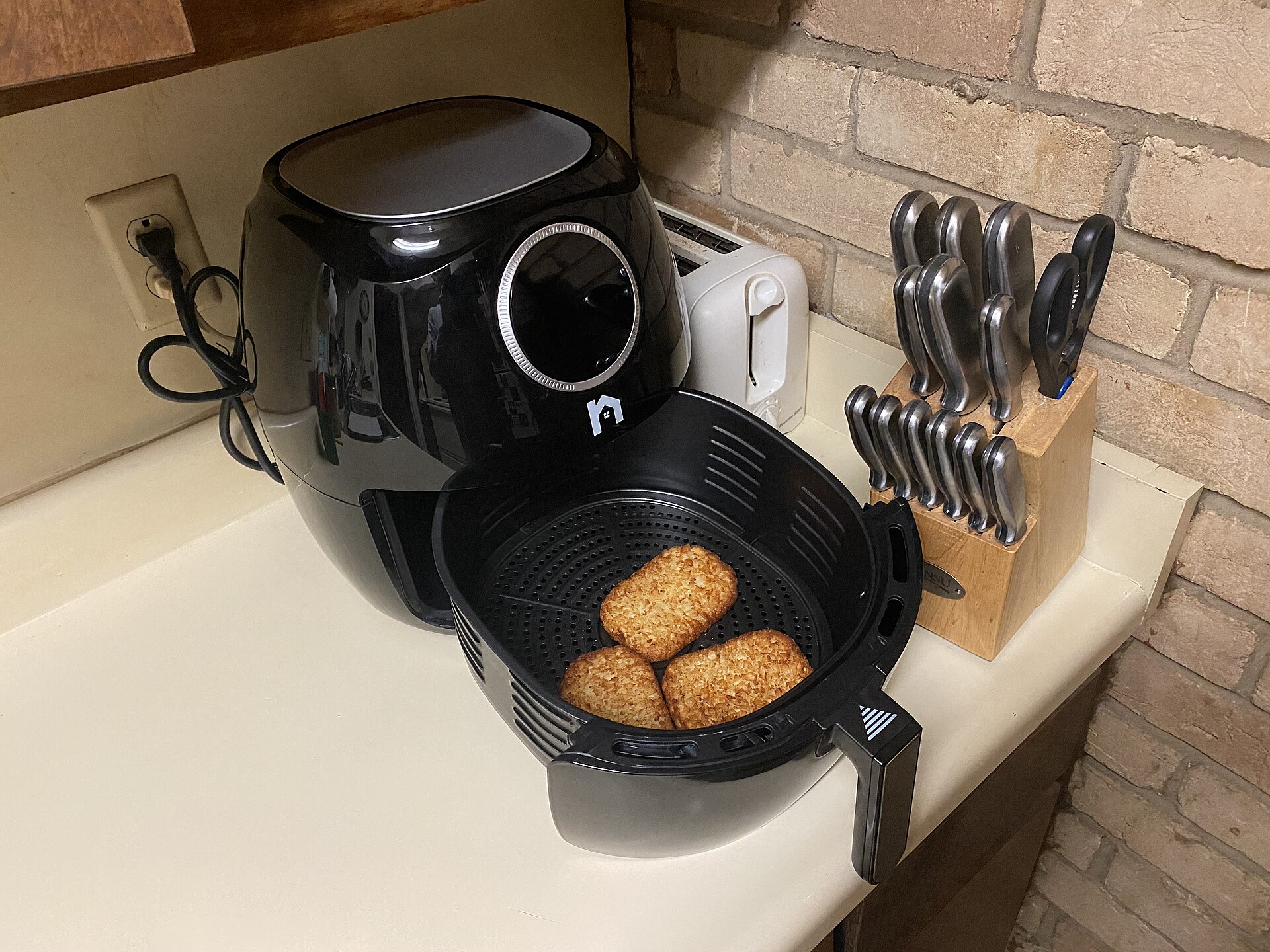
An air fryer does not fry anything. There is no oil to fry in — that is the whole point, and also the giveaway. What sits on your counter is a small, fast convection oven: a heating element, a powerful fan, and a perforated basket, working together to blast food with superheated air until it browns. It is a genuinely useful appliance, and the marketing around it is genuinely overblown. This is a research-based verdict — no hands-on testing, just what the machine does and what the evidence says.
Inside an air fryer, a heating element warms the air and a fan pushes it around the food at high speed. The perforated basket lets the air reach most of the food's surface at once. The browning comes from the Maillard reaction — the same chemistry that browns a steak or a slice of toast — which kicks in once the food's surface passes roughly 140–165°C. The small chamber is the secret: it heats up fast, holds its temperature, and needs far less energy than a full-size oven to do the same job. The US Department of Agriculture describes air fryers plainly as countertop convection ovens, and notes they can cook faster and use less energy than larger ovens. The "frying" is a metaphor. The heat is real.
The concept predates the gadget by decades. In 1945, an American inventor named William L. Maxson built the Whirlwind Oven: a 35-pound box of aluminium and steel with a fan at the back, a 120-volt DC motor of the kind used in aircraft, and room for six meals. Maxson had started out making frozen meals for American servicemen crossing the Atlantic — an upgrade from cold sandwiches and K-rations — and he needed a way to reheat them fast. His oven could cook six meals in about fifteen minutes, half the time of a regular oven. It was written up in Popular Mechanics and Popular Science, and Pan Am used it to serve passengers. Then Maxson died in 1947, his children sold the company, and the idea went quiet for sixty years. The first modern countertop air fryer was SEB's Actifry, launched in France in 2006. The breakthrough came in 2010, when Dutch inventor Fred van der Weij partnered with Philips and launched the Airfryer at the IFA trade fair in Berlin, built around a patented technology called Rapid Air.
Where the air fryer earns its counter space is speed and crispness with very little oil: roast vegetables, reheated leftovers, frozen snacks and chicken wings come out browned and fast. A 2017 study found air-fried potatoes contained on average 70 percent less fat than the same potatoes deep-fried. Where the claims get shaky is health. Air frying reduces acrylamide — a compound that forms when starchy foods are cooked at high temperatures — in some tests: one peer-reviewed study measured a 47 percent reduction in air-fried fries compared with deep-fried ones. But other estimates run as high as 90 percent under different conditions, and at least one study found air-fried potatoes with the highest acrylamide of the methods tested, though the difference was not statistically significant. The honest summary is that the reduction is real in some tests and unsettled overall — not the clean number the ads suggest. And the machine has hard limits: the basket is small, so cooking for a family means batches; wet batters drip straight through the perforations; and it cannot do what a deep fryer does to a doughnut.
It depends on what you cook and how many of you there are. For one or two people who roast vegetables, reheat leftovers and crisp frozen food several times a week, it is a fast, cheap-to-run little oven that earns its place. For a large family, or for anyone who already owns a good convection oven, it is mostly a duplicate with a smaller basket. The honest pitch is less exciting than the ads, but it is still a good one: not a fryer, not a health miracle — a small oven that blows hot air very fast, built on an idea that started with frozen meals on a wartime aeroplane.
Buy the air fryer for what it is and you will probably love it: a quick, compact convection oven that crisps things with a spoonful of oil. Buy it for what the box promises — guilt-free frying, a health transformation — and you will be disappointed, because no appliance can fry without oil or make a chip healthy. The best kitchen gadgets are the ones whose real job is smaller than the advert. The air fryer's real job is small, fast and genuinely useful — and eighty years old.
Related on Poptani Labs: Are VPNs worth it? What they actually do — and what they don't, Blue-light glasses: what the trials actually say (and what helps instead), The Humane AI Pin: the $699 gadget that became a paperweight in 10 months. More in this category: Beyond the Hype.
Sources: Recaplica, how air fryers work, Curious About Machines, the physics behind air fryers, Irwin's Megastore, the evolution of air fryers, CoreFeast, the science behind air fryers

