Every product you buy carries a barcode, and every checkout you have ever used ends with the same small beep. The lines look inevitable — as if they were always there, waiting to be printed on things. They were not. They were drawn in the sand on a beach in Miami in 1949, by a graduate student who had quit his degree to think about groceries. It then took twenty-five years, a laser, and a pack of chewing gum to get them into a shop.
In 1948, a supermarket executive walked into the Drexel Institute of Technology in Philadelphia and asked for a way to read product information automatically at the checkout — to make queues move faster and stocktaking easier. A graduate student named Bernard Silver overheard the conversation and mentioned it to his friend Norman Joseph Woodland, a fellow Drexel graduate and inventor. The dean refused to let them work on it. Woodland was so taken with the problem that he quit graduate school that winter, took some of his grandfather's stocks, and moved to his grandfather's apartment in Miami Beach to think about it full-time. He spent the winter of 1948–49 sitting in a beach chair, stuck.
Woodland had learned Morse code as a Boy Scout, and one day on the beach it came back to him. "I remember I was thinking about dots and dashes when I poked my four fingers into the sand and, for whatever reason — I didn't know — I pulled my hand toward me and I had four lines," he recalled later. "I said: Golly! Now I have four lines and they could be wide lines and narrow lines, instead of dots and dashes." Then, only seconds later, he swept his fingers round into a circle — the bullseye design, which could be read from any direction. He and Silver filed a patent for their "Classifying Apparatus and Method" on October 20, 1949. It was granted on October 7, 1952, covering both the straight lines and the bullseye, plus a prototype scanner. They later sold the patent to Philco for $15,000 — a substantial sum at the time.
The idea was too early. The barcode needed cheap lasers, which did not exist until 1960, and computers fast enough to look prices up in real time. It also needed an industry to agree on a single standard — no shop would print codes that only its own tills could read. That took until 1973, when a committee settled on the Universal Product Code, designed by IBM engineer George Laurer: the familiar rectangle of vertical bars with a twelve-digit number underneath. Every manufacturer would print the same code for the same product, every scanner would read it, and the price would live in the shop's computer, not on the packet. The bullseye was gone; the lines had won.
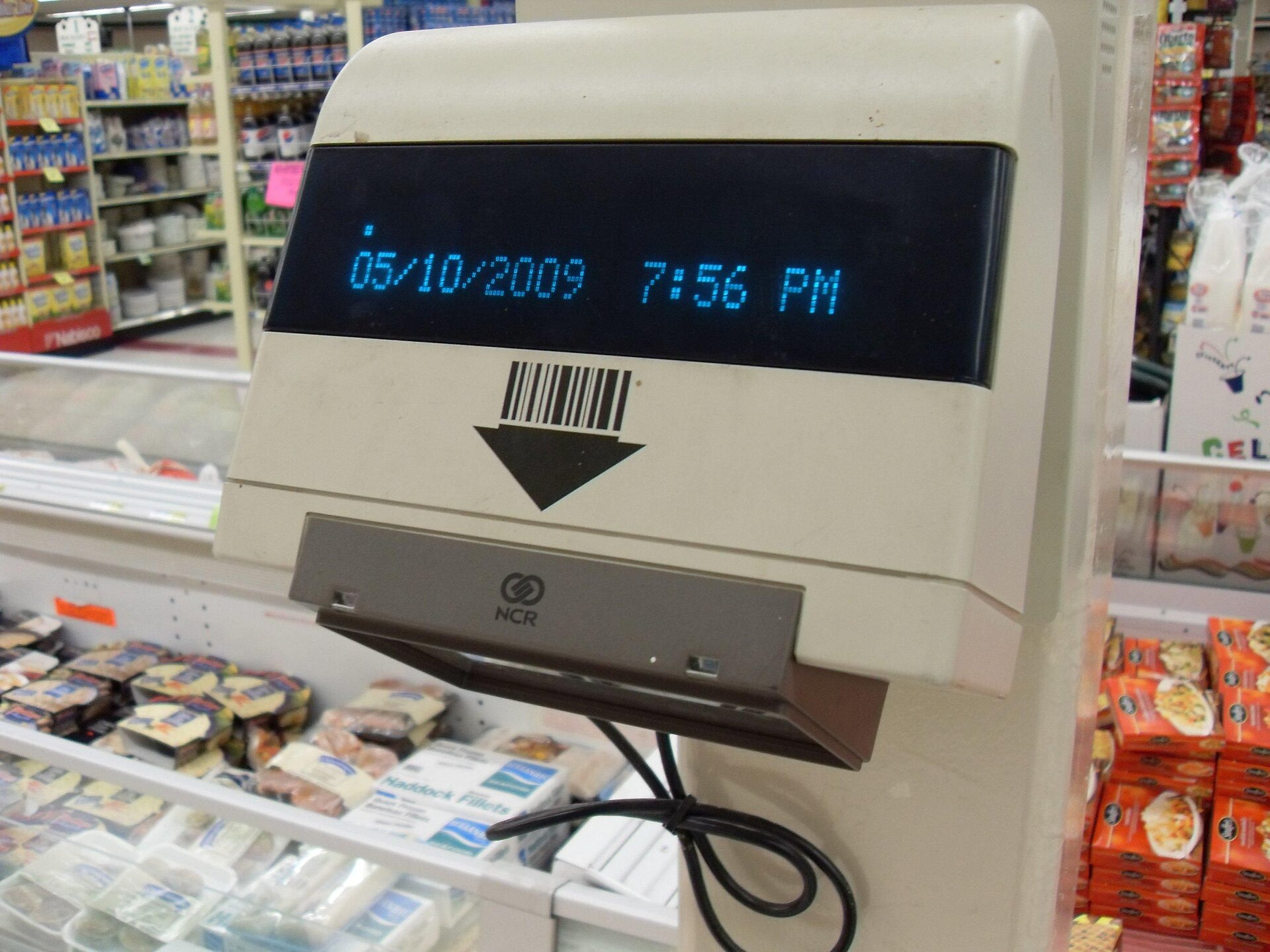
On June 26, 1974, at 8:01 in the morning, the first product marked with a UPC was scanned at the checkout of Marsh's supermarket in Troy, Ohio. The cashier was Sharon Buchanan. The shopper was Clyde Dawson, Marsh's head of research and development, who had filled a basket for the occasion. He pulled out a ten-pack of Wrigley's Juicy Fruit chewing gum — 67 cents — and Buchanan ran it across the scanner. It beeped, and the price appeared on the register. The choice of gum was deliberate: sceptics had doubted a barcode could be printed on something as small as a pack of gum, and Wrigley had found a way to do it. The pack is now in the Smithsonian's National Museum of American History, alongside the early scanners. The National Cash Register company had fitted the store with a $10,000 checkout counter and a $4,000 scanner — a small fortune, for one beep.
The barcode's lesson is that a good idea is not enough — it needs the world to catch up. Woodland's four lines in the sand waited through the invention of the laser, the spread of cheap computing, and a decade of committee meetings before they could do the job they were drawn for. And the job was never glamorous: no one writes songs about stocktaking. But look at any supermarket shelf and you will see the result — millions of products, each carrying a few lines that say what it is, where it came from, and what it costs. All of it, from a man on a beach, thinking about dots and dashes.
Related on Poptani Labs: How a QR code survives scratches, smudges and a bad camera angle, How a microwave oven actually heats your food (and why metal sparks), How a website actually works: from typed address to page on your screen. More in this category: Built in the Lab.
Sources: Chris Myers, A Linear Morse Code, Sew Colorful, History of the Bar Code, AlphaTechs, who invented the barcode scanner

