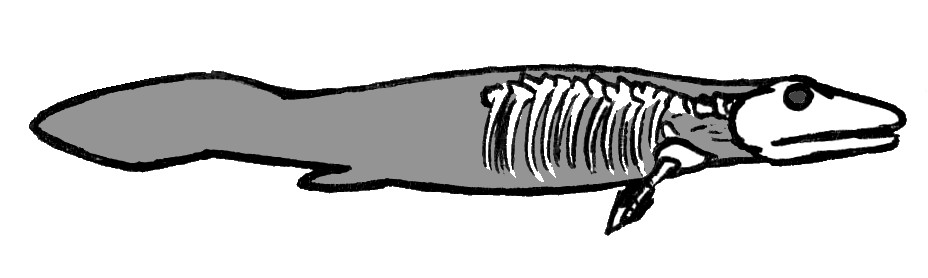
After his much-watched 2014 debate with creationist Ken Ham, Bill Nye wrote Undeniable: Evolution and the Science of Creation to make one big case: science is not a belief system — it is a way of knowing, and its superpower is prediction. A story explains the past. A theory tells you where to dig. And Nye's favourite exhibit for that claim is a 375-million-year-old fish that evolution ordered before anyone had seen it.
The fossil record had a gap. On one side, Panderichthys, a lobe-finned fish about 385 million years old. On the other, the earliest four-legged tetrapods, about 365 million years old. In the late 1990s, paleontologists Neil Shubin (University of Chicago), Ted Daeschler (Academy of Natural Sciences) and Farish Jenkins Jr. (Harvard) reasoned that something in between — neither fully fish nor fully tetrapod — must be sitting in rocks around 375 million years old. The trick was finding such rocks: the right age, exposed, and not buried under a city.
Geology maps led them to Ellesmere Island in Canada's Nunavut, roughly 600 miles from the North Pole — polar-bear country with Devonian rocks laid down by ancient river deltas. After several summer expeditions came up empty, the fifth — 2004 — delivered Tiktaalik roseae, named with the help of Inuit elders. Shubin's team had predicted a missing link, gone to the exact shelf where evolution said it should be, and found it waiting.
Sources: Wikipedia — Undeniable, Quanta — Neil Shubin interview
Tiktaalik is the perfect half-and-half animal. Scales, fins, gills and a lower jaw like a fish — but also a neck (no fish has a neck), a flat crocodile-like skull with eyes on top, robust ribs, and inside its forefins: shoulder, elbow and partial wrist bones, letting it prop itself up on the riverbed "as if it were doing push-ups." Shubin's joke name for it was the "fishapod."
Nye leans on it in his chapter answering the classic creationist challenge — "what good is half a wing?" Tiktaalik's half-limbs were not a failed prototype of an arm; they were a complete success at being Tiktaalik: cruising shallow streams, eyes scanning the surface for prey, able to haul itself onto the bank. Transitional doesn't mean incomplete. Every organism is fully equipped for its own niche — the "half" only exists in hindsight.
Sources: Scientific American, Wikipedia — Tiktaalik, Bookey — Undeniable chapter summary
Before he was the Science Guy, Nye was a Boeing mechanical engineer designing 747 hydraulic systems — until friends badgered him into a Warner Brothers-sponsored Steve Martin look-alike contest in Seattle. He won. That led to stand-up comedy by night, a writing gig on Seattle's Almost Live!, and then the break: a guest no-showed, and Nye filled six minutes with "household uses of liquid nitrogen" — marshmallows frozen and smoked through his nose, an onion shattering like glass. A co-host's throwaway remark gave him the name: Bill Nye the Science Guy.
Nye's argument endures because it is falsifiable in exactly the way that matters. If no transitional fossil had ever turned up where the theory pointed, evolution would have had a real problem. Instead, the prediction was tested — with a shovel, in the Arctic — and passed. A theory that tells you where to dig is a theory that is doing work.

