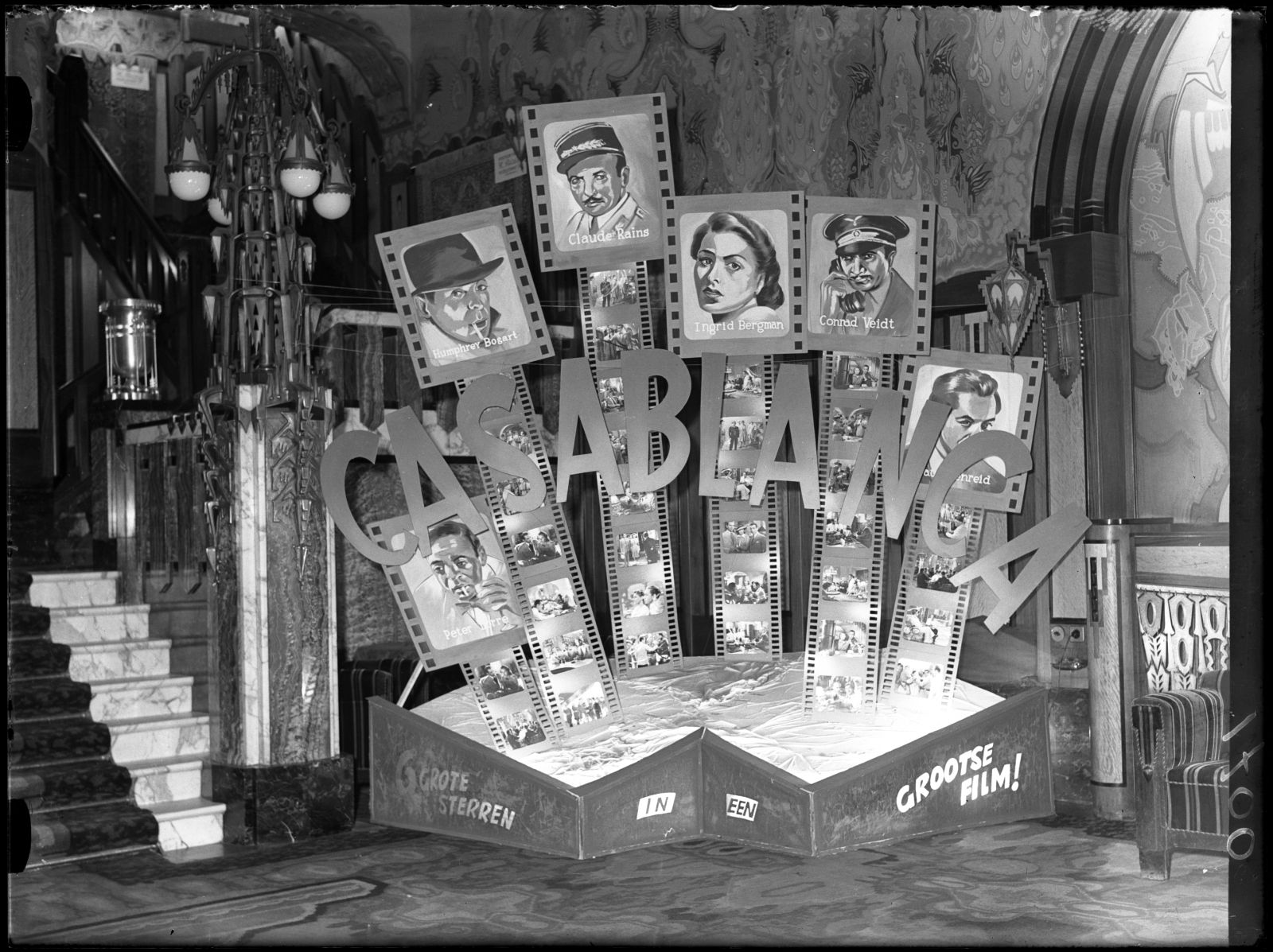
Ask anyone to quote Casablanca and the answer comes back instantly: “Play it again, Sam.” Humphrey Bogart, a smoky piano bar, a lost love. There is only one problem with it. Nobody in the film ever says it. The most famous line in cinema history is a line that was never spoken — and the story of how it got into everyone's head anyway is almost as good as the film itself.
Casablanca (1942), directed by Michael Curtiz, is set in French Morocco during the Second World War. Rick Blaine (Bogart) runs Rick's Café Américain, and into it walks Ilsa Lund (Ingrid Bergman), the woman who left him in Paris. She spots Sam (Dooley Wilson), the house pianist, and asks him to play the song that was theirs: “Play it once, Sam. For old times' sake.” Then, more urgently: “Play it, Sam. Play ‘As Time Goes By.’” Sam resists — Rick has forbidden him to ever play that song — but she insists, and he plays. Rick storms over, furious that Sam has disobeyed his order, and then he sees her. Later, Rick himself says: “You played it for her, you can play it for me… Play it!” The word “again” never appears. Not once. The tidy version of the line is a compression of two separate moments, stitched together by decades of people misremembering.
Here is the fun part: Dooley Wilson, the man at the piano, could not play the piano at all. The playing you hear in the film was dubbed — credited for decades to Elliot Carpenter, though payroll records and a forensic musicologist point instead to studio pianist Jean Plummer. Wilson mimed it so convincingly that generations of viewers assumed the music was his. The song itself, “As Time Goes By,” was written by Herman Hupfeld in 1931, eleven years before the film, and the composer Max Steiner disliked it so much he lobbied to replace it with an original number. It stayed — and became one of the most famous songs in film history. The production was chaotic in other ways too: the script, adapted from the unproduced play Everybody Comes to Rick's by Murray Burnett and Joan Alison, was still being rewritten as filming went on. The film's final line — “Louis, I think this is the beginning of a beautiful friendship” — was added after filming had wrapped, and Bogart came back a month later to dub it.
So where did “Play it again, Sam” come from? The main suspect is Woody Allen. His 1969 Broadway play — and the 1972 film of the same name, directed by Herbert Ross — was called Play It Again, Sam, and it put the tidy version of the line on a marquee for millions of people who had never watched Casablanca closely enough to notice. But Allen was really just writing down what everyone already thought they remembered. The misquote is simply a better line than the real ones: “again” adds the longing, the history, the whole weight of a romance that ended in Paris. It says in four words what the scene takes two minutes to say. Memory prefers the version that means more, even when it is wrong.
The irony is that Casablanca hardly needed the help. Six of its lines made the American Film Institute's list of the 100 greatest movie quotes — more than any other single film. “Here's looking at you, kid,” which Bogart improvised (it was a popular expression of the 1930s), and “Louis, I think this is the beginning of a beautiful friendship” are both genuinely in the film. The film won three Academy Awards in 1944, including Best Picture. And the line that isn't in it may be the most quoted of all — proof that a film's afterlife is written as much by its audience as by its screenwriters.
“Play it again, Sam” survives because it says what the scene means better than the scene does. The real lines are scattered, hesitant, interrupted — like real memory. The fake one is clean, complete, and instantly quotable. Eighty-four years on, the misquote is a reminder that the movies we carry in our heads are never quite the movies that were made — and sometimes the version we invent is the one that lasts.
Related on Poptani Labs: Tears in rain: the Blade Runner speech Rutger Hauer rewrote the night before filming, The shark that wouldn't work: how Jaws' broken robot made the scariest movie ever, Ozymandias: the Breaking Bad episode that earned TV's only perfect score. More in this category: Screen Time.
Sources: Steve Pafford, Play it again, Sam: rewatching Casablanca at 80, Film Forum, Rules Before We Break Them — Casablanca, Screen Age Wasteland, Let's Talk About Casablanca (1942), European Film Star Postcards, Casablanca

