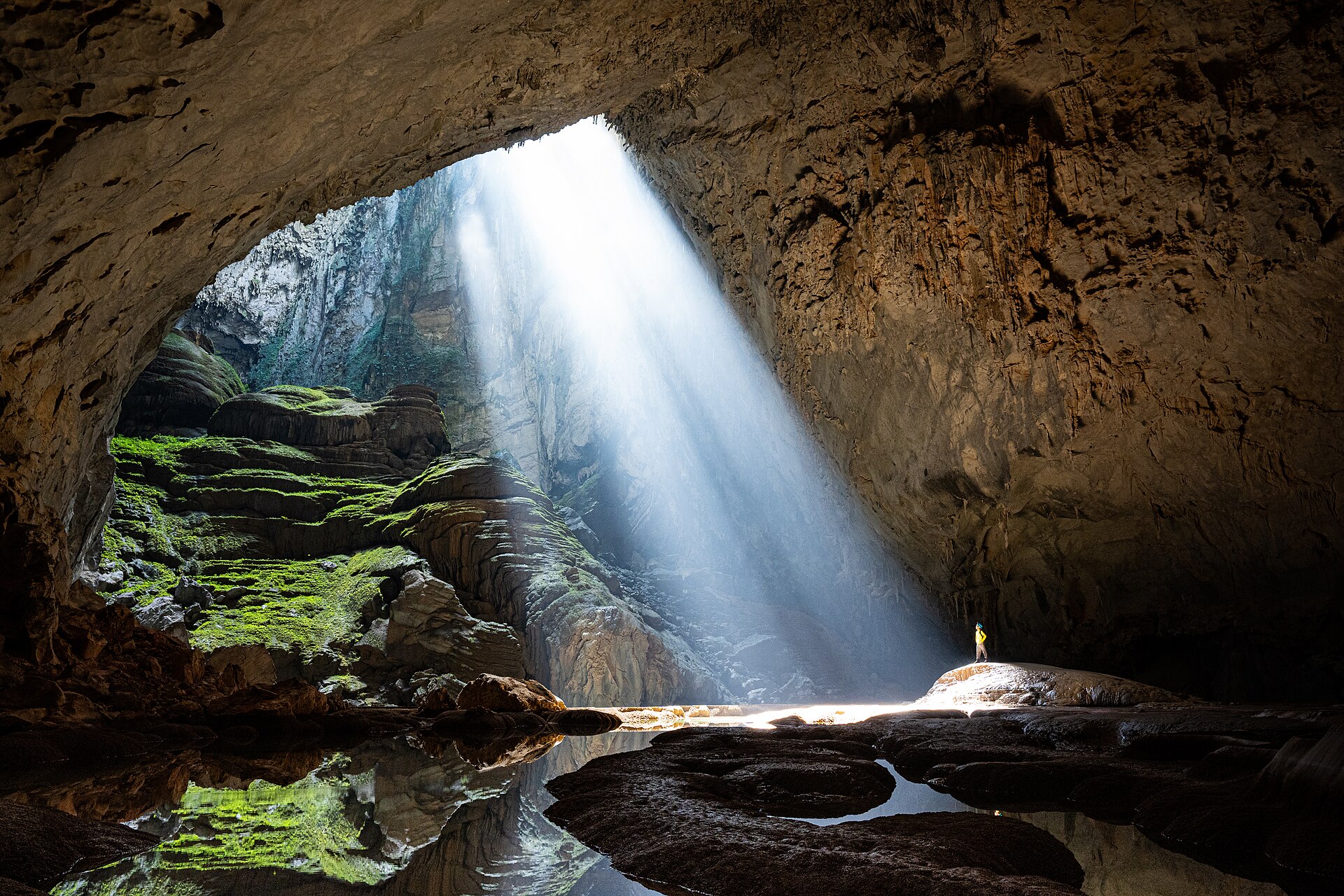
Somewhere in the jungle of central Vietnam, there is a cave with clouds in it. Not mist, not damp air — actual clouds, forming and drifting under a rock ceiling, above a jungle that grows in permanent twilight. Hang Son Doong, in Quang Binh province's Phong Nha-Ke Bang National Park, is the largest cave on Earth by volume, and it spent millions of years completely unknown to the outside world. It was found by accident, then lost again for nearly two decades. This is a research-based account, drawn from expedition reports and the guides who run trips there — the cave is not a place a writer can casually drop into.
The numbers are hard to picture, so here they are anyway. Son Doong runs for more than 9 kilometres through limestone under the Annamite Mountains, with chambers up to 200 metres high and 150 metres wide — tall enough to hold a 40-storey skyscraper, with room to spare. Its total volume is about 38.5 million cubic metres, and in 2013 Guinness World Records recognised it as the world's largest natural cave. Mammoth Cave in the United States is longer, but Son Doong is bigger by volume, which is the measure that counts here. The name combines Son, meaning mountain, with Doong, the valley the Rao Thuong stream runs through.
It is so big that parts of its roof have collapsed, leaving two enormous skylights called dolines. Sunlight pours through them, rain falls through them, and a primeval forest grows beneath them, deep underground. Warm air from above meets the cool cave air and clouds form inside. An underground river winds through the darkness, and stalagmites inside the cave grow to more than 80 metres tall. The cave began forming a few million years ago, when a river found a crack in the limestone and spent the ages widening it, dissolving the rock as it flowed — Purdue University geologist Darryl Granger, who has studied the cave, puts the start of that carving at around 2.5 million years ago. The same river still runs through it, and every monsoon pushes the process a little further. The largest cave on Earth is not a finished monument. It is still being carved, in the dark, by water.
The cave's discoverer was not an explorer. Ho Khanh was a local man from Phong Nha town who, in late 1990, was sheltering from a storm in the jungle when he noticed wind and clouds of fog blowing out of a crack in the ground. He did not go in — the entrance dropped away steeply, and he had no rope or lights — and when he moved away from the area, he forgot exactly where it was. Years later, in 2007, British caver Howard Limbert heard Khanh's story and asked him to find the entrance again. Khanh searched and failed. He went back alone in 2008 and searched until he found it, marking the spot carefully before heading home.
In March 2009 Limbert returned with an expedition team, and on 7 April a team member, Peter MacNab, became the first person to set foot inside. Laser measurements taken on that expedition confirmed what Khanh had suspected from the wind alone: this was the largest cave in the world. Khanh had spent almost eighteen years trying to find, again, a hole he had stumbled across by accident — and today there is writing on the wall outside the entrance proclaiming the miracle of Ho Khanh.
Inside, the cave behaves less like a cave and more like a lost world. The underground jungle grows under the dolines, the river runs through chambers so large that expeditions camp inside them, and the temperature stays around 22 to 25 degrees Celsius all year. The cave is open to visitors only from January to August; from September to December it closes, because monsoon rains can flood the passages. The only way in is a multi-day guided expedition run by Oxalis Adventure, the licensed operator, and numbers are strictly limited — which is why, more than a decade after the first tours in 2013, much of the cave system is still being mapped. Divers have already found that Son Doong connects to neighbouring caves, making the system larger than the first surveys suggested. There is no phone reception inside, and no shortcut in: reaching it still means days of jungle trekking, just as it did for the team that first measured it.
Son Doong is a reminder that the map still has blank spaces — or did, until very recently. The largest cave on Earth was found by a man sheltering from a storm, lost for eighteen years, and confirmed by a team with laser scanners. It has a jungle, a river, and weather of its own, and it is still growing. If you ever get the chance to stand under one of its skylights, take it: few places on Earth make a person feel quite so small, or quite so lucky to be there.
Related on Poptani Labs: Coober Pedy: the Australian town that lives underground, Longyearbyen: the Arctic town where you're not allowed to die (almost), Giethoorn: the Dutch village with no roads — only canals. More in this category: Around the World.
Sources: Oxalis Adventure, 'Jungle man Ho Khanh and the finding Son Doong story', IFLScience, 'Hang Son Doong: A Man Discovered The World's Largest Cave By Chance', AsiaViva Travel, 'Explore Son Doong Cave: Discover What Lies Inside the World's Largest Cave'

