Imagine it: mid-afternoon, everywhere on Earth at once, gravity simply stops. Your coffee hangs in the air. Your chair stops pressing against you. For five seconds, the whole planet is weightless — and then, just as suddenly, gravity switches back on. It sounds like a scene from a film, and the internet loves to imagine it as either harmless fun or instant apocalypse. The real physics, worked out step by step, is stranger than either version. This is a research-based thought experiment: no one has ever switched gravity off, and nothing in physics says it can be.
Gravity is not a switch. In Einstein's general relativity, gravity is the curving of spacetime caused by mass — as long as Earth has mass, its gravity exists automatically. So the scenario is impossible in the strict sense, and the exercise is to bend one rule and follow the consequences honestly: for exactly five seconds, the gravitational pull between every pair of masses is set to zero, everywhere, and then restored. Everything else stays the same. Atoms still hold together, pressure still pushes, Earth keeps spinning, and every object keeps whatever velocity it had the instant gravity stopped.
Losing gravity gives you no upward push. Newton's first law says an object keeps moving at whatever velocity it already had unless a force acts on it. You were standing still relative to the ground, so you would simply stay where you are — weightless, but not rising. What does change is that the ground beneath you keeps curving away as Earth spins. At the equator, where the surface races east at about 1,670 km/h, a freely floating person would separate from the curving ground by only about 0.42 metres in five seconds. That is the whole drama of it: not a launch into space, but a gentle drift. Loose objects — papers, phones, coffee — would hang in the air where they were, while anything bolted down stays bolted down. If the Earth stopped spinning instead, the story would be very different — as we explored in What if the Earth stopped spinning tomorrow?
Air and water are different, because they are held down only by gravity. With nothing holding it, the atmosphere would begin to expand outward into space, and the pressure at the surface would start to fall. Five seconds is far too short for the air to actually escape — the top of the atmosphere would barely begin to move — but the expansion starts immediately, and every gas molecule keeps the velocity it had, including Earth's spin. The oceans, meanwhile, are pressed flat by gravity; release that pressure and the water starts to bulge and slosh upward, though again, five seconds is not long enough for the seas to leap skyward. The popular image of the oceans flying off into space in seconds is wrong on the timescale. If everyone on Earth jumped at once, the effect would be similarly tiny — see What if everyone on Earth jumped at the same time?
Here is a true story that fits this thought experiment almost exactly. NASA has a machine that gives researchers almost precisely five seconds of weightlessness. The Zero Gravity Research Facility at NASA's Glenn Research Center in Cleveland, Ohio, is a 432-foot drop tower — the largest of its kind in the world — in operation since 1966. An experiment package is dropped 132 metres down a vacuum chamber, and during the fall it experiences near-weightlessness for 5.18 seconds before being caught by a decelerator cart filled with polystyrene beads. Scientists use those five seconds to study how flames burn and fluids behave without gravity. So the closest real-world version of our scenario is not a disaster movie: it is a carefully engineered fall, repeated for decades, five seconds at a time.
Five seconds in, gravity returns, and that is when the trouble starts. Everything that drifted upward — people, furniture, water that bulged — falls back down. A person who drifted half a metre up lands with a thud, not a catastrophe, but the oceans would come down as surging waves, and structures stressed by the sudden release and return of pressure could crack. The Moon and the satellites would also be slightly off course: in five seconds of free drift, the Moon's path shifts by a small amount, but its orbit would survive — five seconds is a blink against a 27-day orbit. The real damage would be the sloshing: waves from oceans that rose and fell, and a planet-wide mess of broken glass and bruised ankles rather than the end of the world.
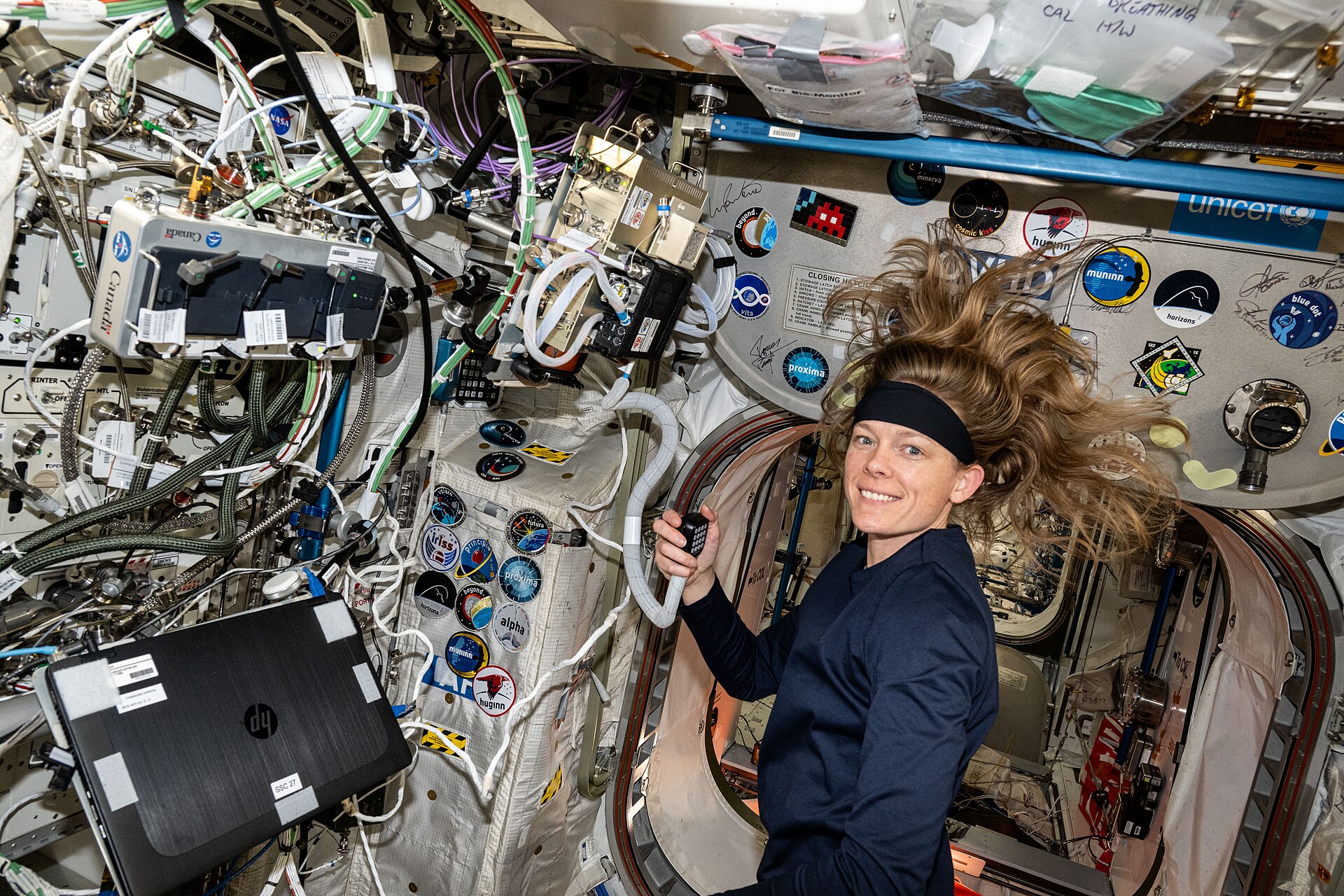
Five seconds of no gravity would be weird, messy, and survivable for most of us — and the real lesson is that gravity is doing far more quiet work than we notice. It holds the air down, presses the oceans flat, and keeps the ground under our feet even as the planet spins at 1,670 km/h beneath us. The astronauts aboard the International Space Station know this better than anyone: they float not because gravity is gone — at 400 km up it is still about 90% as strong as on the ground — but because they are falling around Earth together, at 28,000 km/h, never landing. Five seconds of weightlessness is a gift scientists chase in drop towers and astronauts live in every day. A planet-wide version would be a very different story — and one we are lucky exists only in thought experiments.
Related on Poptani Labs: What if the Earth stopped spinning tomorrow?, What if everyone on Earth jumped at the same time?. More in this category: What If?.
Sources: HowStuffWorks — What Would Happen if Earth Lost Gravity for Five Seconds?, NASA — Zero Gravity Research Facility, Space.com — How Fast Is Earth Moving?, Space Unpacked — Why Astronauts Float: The Real Reason for Weightlessness

