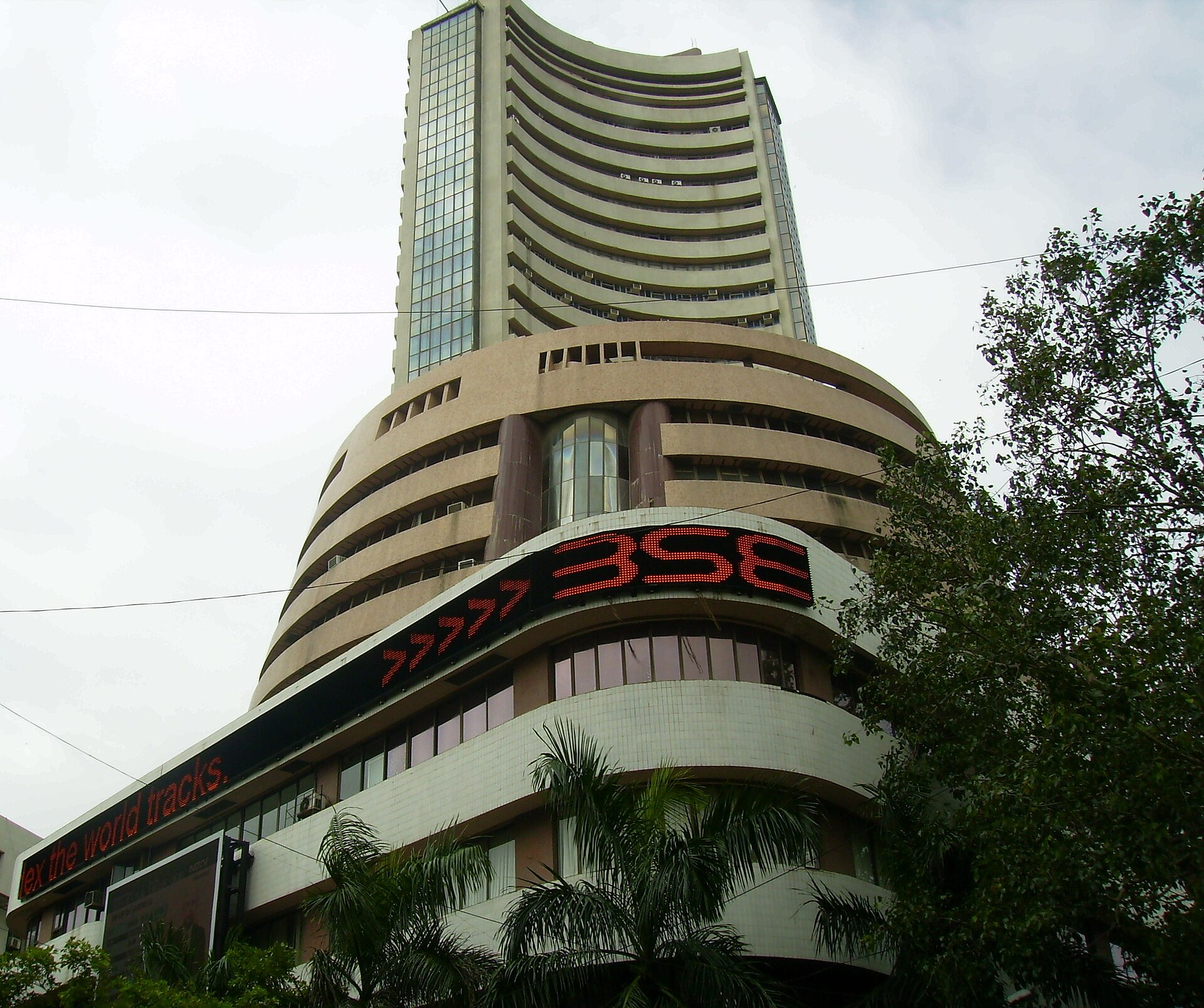
Monday was a whiplash day on Dalal Street. After the strongest week in six months — the Sensex and Nifty rallied roughly 3% last week — both benchmarks snapped their two-day winning streak and then some: the Sensex plunged 876.37 points (1.17%) to 73,852.90, and the Nifty 50 fell 257.20 points (1.11%) to 22,888.95. Breadth was ugly: 2,925 shares declined against 1,163 advancers. (A note on timing: you're reading this on Dussehra, when NSE and BSE are closed — trading resumes Wednesday, October 21, at 9:15 AM IST.)
Sources: The Hindu BusinessLine, HDFC Sky, Upstox
Here is the week's "wait, really?" moment. Axis Bank reported a standalone net profit of ₹7,003.3 crore for Q2 FY27 — up 37.6% from a year ago, the strongest profit growth among the big private banks. Its net interest income rose 11.8% to ₹15,371 crore (beating the Street's ₹14,970 crore estimate), advances grew 23%, and gross NPAs improved to 1.16%.
The stock fell as much as 5%, closing down 4.2% as the Nifty's biggest loser. Why? Because in markets you are never measured against last year — you're measured against what everyone already priced in. Analysts expected ₹7,132 crore (CNBC-TV18 poll) / ₹7,124 crore (LSEG), and Axis missed by a whisker: ₹7,003 crore. Net interest margin slipped to 3.36% (3.47% excluding the cost of FCNR-B deposits), operating expenses rose 8.7%, and treasury income was soft. The lesson: good numbers can still disappoint if the expectations were better.
Sources: Analytics Insight, Flash Finance, MyFinBright
Axis wasn't alone. HDFC Bank fell about 2% despite posting ₹19,510 crore in net profit (+4.7%) — its treasury gains reportedly dropped 67%. ICICI Bank slipped ~1.15% even though its ₹14,843 crore (+20.1%) profit beat estimates. IT joined the selloff too: the Nifty IT index fell 1.3%, with LTIMindtree down 2.8% after its profit missed forecasts.
But here's the split that matters: public-sector banks went the other way. The Nifty PSU Bank index rose about 2%, with PNB jumping as much as 7.7% after strong quarterly numbers, and SBI, Indian Bank and Central Bank of India all ending in the green. Two banks, two earnings seasons, one Monday.
Sources: The Geneva Times, Univest
The bigger story beneath the noise: foreign selling is losing steam. FIIs were net sellers for a ninth straight week — but the weekly outflow collapsed to ₹8,991 crore from ₹30,294 crore the week before. And on Friday, October 16, FIIs actually turned net buyers of ₹1,166 crore — a small green shoot after months of relentless selling. DIIs kept doing their job, buying ₹7,813 crore for the week; month-to-date, DII buying (₹48,168 crore) has almost exactly absorbed FII selling (₹48,769 crore).
Perspective check: FIIs have still pulled roughly ₹3.04 lakh crore out of Indian equities in 2026, and the Nifty remains about 12% below its 52-week high of 26,373.20. The bleeding is slowing — it hasn't stopped.
Sources: Flash Finance, Nation Press, Horizon Desk
Rewind to October 7: the RBI raised the repo rate to 5.50% — its first hike since February 2023 — and flipped its stance to "calibrated tightening," with a FY27 CPI forecast of 5.2% (Q3 seen at 6.0%). Then it went to work on the rupee: a special dollar window for oil-marketing companies, tighter hedging norms, and a 20% cash reserve requirement on FX derivative trades above $2 million. The result — the rupee rose roughly 2% in the week ended October 16, its best run in a long time, settling around ₹94.89–94.92 to the dollar.
The fun detail nobody puts in the headline: a defended rupee has a cost. Forex reserves dropped $8.578 billion to $726.027 billion in a single week (ended October 9). The RBI is spending real money to buy calm — and Brent crude is still hovering around $105–108, so every barrel keeps the pressure on.
Sources: Conviction Caution, ScoopFeeds, Horizon Desk
Lost in the selloff: SEBI reversed its plan to settle expiring derivatives using the closing auction, sticking instead with the volume-weighted average price of the last 30 minutes. Traders had worried the closing-auction method would concentrate volatility; the reversal removed one source of anxiety — and was one of the quiet supports behind last week's rally.
Source: Whitefang64 (market diary)
In October 1987, the week of Black Monday, portfolio insurance — a newfangled hedging idea — was supposed to make markets safer. Instead it automated the selling and turned a correction into a cascade. The tool designed to remove risk became the risk.
This week, India is living the mirror image: the one tool that is actually working is the dullest one of all — DIIs and their steady SIP inflows, buying every FII sell order almost rupee for rupee. No cleverness, no leverage, just monthly patience. Sometimes the most boring instrument in the room is the one holding up the ceiling.
What to watch: October PMI data (domestic demand pulse), the RBI MPC minutes (how hawkish the "calibrated tightening" really is), and the rest of Q2 earnings — financials, consumption and industrials now have to prove the recovery can broaden beyond IT. Markets reopen Wednesday, 9:15 AM IST.
Don't just read about it — run the numbers on your own money with the same calculators this post draws on.

