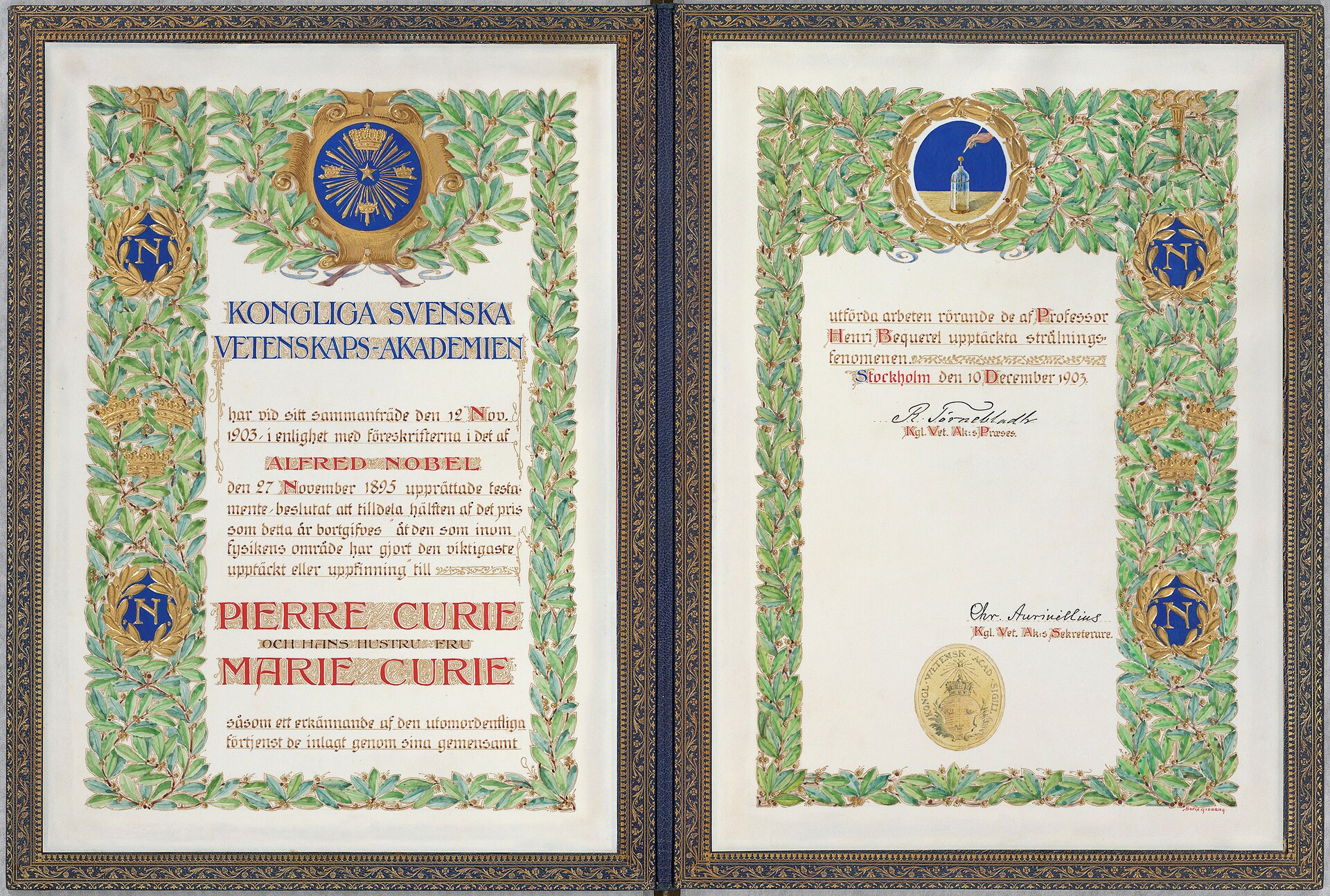
In the basement of the Bibliothèque nationale de France in Paris, there is a collection of notebooks that cannot be casually browsed. They sit in lead-lined boxes, carefully preserved and carefully contained. If you want to read them, you must sign a liability waiver and wear protective clothing. They are the laboratory notebooks of Marie Curie — and they are still radioactive, more than a century after she last touched them. Curie is the only person in history to win Nobel Prizes in two different sciences, Physics in 1903 and Chemistry in 1911. This is a research-based piece — her story, told from the record, not a visit to the archive.
The notebooks cover the years when Curie and her husband Pierre did the work that made them famous. Starting in 1898, in a leaky, unventilated shed on the Rue Lhomond in Paris, they processed tonnes of pitchblende — a uranium ore from Bohemia — grinding, boiling, dissolving and recrystallising it, looking for the unknown element that made the ore more radioactive than the uranium in it should have been. They found two: polonium, named for Marie's native Poland, and radium. By 1902, after nearly four years of work, Marie had isolated about one-tenth of a gram of radium chloride — a speck, less than the weight of a grain of rice — and measured radium's atomic weight at 225, close to the modern value of 226. The shed had no ventilation, no fume hoods, and no concept of radiation safety, because the concept barely existed yet. The Curies were inventing the science as they worked, and breathing it in as they went.
Marie carried test tubes of radium in her pockets. In her autobiography she described the glowing tubes as looking like faint fairy lights, and she found them beautiful. The beauty was the poison: she died on July 4, 1934, of aplastic anemia, almost certainly caused by her prolonged exposure to radiation. She was so radioactive when she died that her body was placed in a lead-lined coffin, and when her remains were moved to the Panthéon in 1995 — the first woman interred there on her own merit — the coffin was shielded with lead because her bones remain measurably radioactive. Her cookbooks are contaminated. Her furniture is contaminated. The doorknobs of her old apartment were contaminated. Her former laboratory was only fully decontaminated in 1991, nearly sixty years after her death.
The culprit is radium-226, the isotope that contaminates the pages, and it has a half-life of about 1,600 years. That means the radium Curie tracked onto her notebooks on her fingertips in 1902 has decayed by less than five per cent in the century since. The pages emit alpha, beta and gamma radiation; the gamma rays pass straight through paper and skin, which is why the lead-lined storage is necessary. Experts estimate the notebooks will not be safe to handle without protection until around the year 3500 — roughly 1,500 years from now. The Christian Science Monitor once noted the reversal neatly: most library collections use special equipment to protect the archival materials from the visitor. For the Curie collection, it is the other way around.
It would be wrong to remember Curie only as a casualty. She founded the field of radioactivity — she coined the word — and her work opened the door to nuclear physics, nuclear medicine and cancer radiotherapy. During the First World War she built mobile X-ray units, the "petites Curies," that brought imaging to the front lines and are credited with saving countless soldiers' lives. The Radium Institute she founded still stands, now part of the Institut Curie, one of the world's leading cancer research centres. She did all of this as a Polish immigrant woman in a French scientific establishment that did not want her there, and she did it while the work itself was quietly killing her.
Curie's notebooks will outlive everyone reading this post, and everyone reading it in the year 3000, too. They are a monument to both sides of her achievement: the science she built from nothing, and the price she paid without knowing it. The idea to remember is not that genius is dangerous. It is that the most important discoveries are often made before anyone knows what they cost.
Related on Poptani Labs: Carl Sagan and the pale blue dot: the photo that shrank the world, Feynman's glass of ice water: the 30-second demo that explained a disaster, The lemon-juice bank robber: what the Dunning-Kruger effect really says. More in this category: Big Thinkers.
Sources: Kronecker Wallis, Marie Curie's Notebooks Are Still Radioactive After 100+ Years, IFLScience, How Did They Decontaminate Marie Curie's Lab?, ScienceBlog, The shed on the rue Lhomond

