By mid-morning on 28 June 1914, the assassination plot in Sarajevo had already failed. Six young conspirators had lined the motorcade route of Archduke Franz Ferdinand, heir to the Austro-Hungarian throne — and one by one, they had frozen, lost their nerve, or watched the cars sweep past too fast. Then a bomb was thrown, bounced off the Archduke's folded canopy, and exploded under the car behind, wounding officers and bystanders. The Archduke was unhurt, the bomber was arrested, and the royal party carried on to the town hall. History, it seemed, had been spared.
It hadn't. What happened next was not a master plan succeeding — it was a chain of small, ordinary failures, each one invisible on its own, that delivered the Archduke to his killer a second time.
At the town hall, the shaken Archduke interrupted the mayor's welcome speech to point out he had been greeted with a bomb. Then came the fateful decision: rather than leave the city, he would visit the officers wounded in the blast at the hospital. To keep the royal couple out of the crowded old town, Governor Oskar Potiorek changed the route — the motorcade would drive straight along the wide Appel Quay instead of turning into the narrow city streets.
There was just one problem: nobody told the drivers. Potiorek's aide, who should have carried the new route to the chauffeurs, was himself in hospital — wounded in the bombing. The police chief, asked to pass the message on, forgot in the confusion. So when the motorcade set off again, the lead cars turned right at the Latin Bridge, following the original route printed in the newspapers — and Leopold Lojka, driving the Archduke's car, followed them.
Source: Wikipedia — Assassination of Archduke Franz Ferdinand
Potiorek, riding in the Archduke's car, realised the mistake and shouted that this was the wrong way. Lojka braked and wrestled the car into reverse — but the gears ground and stuck, and the big touring car sat motionless in the street for a few fatal seconds.
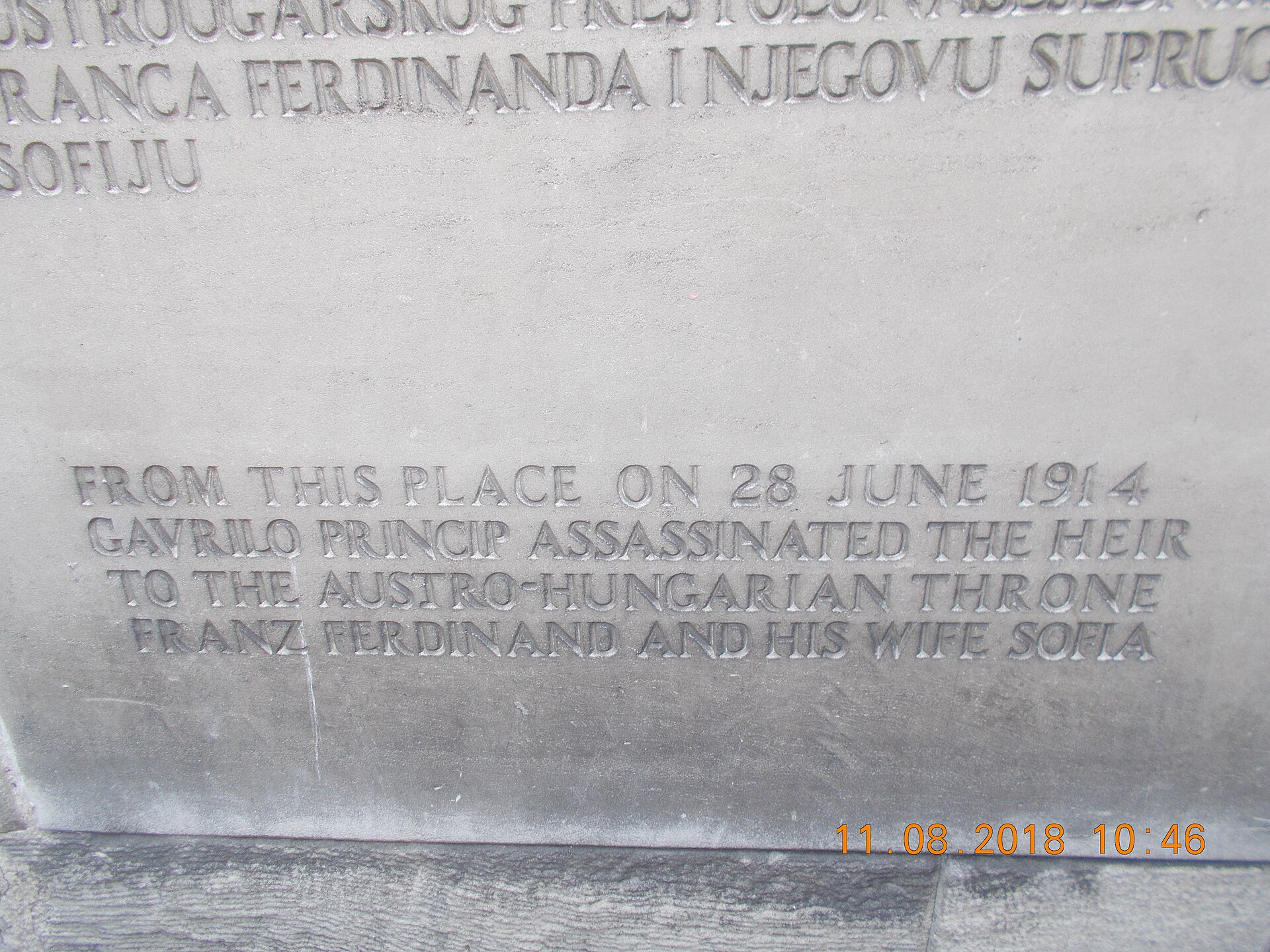
And standing on that exact corner, outside Schiller's delicatessen, was Gavrilo Princip — one of the morning's failed conspirators, who had drifted there after his own chance had passed. The stalled car was roughly three metres away. He stepped forward and fired twice: one bullet struck Sophie in the abdomen, the other struck Franz Ferdinand in the neck. Both were dead within the hour.
The popular story says Princip was eating a sandwich when the car appeared. Historians note there is no contemporary record of a sandwich — sandwiches were hardly a Sarajevo staple in 1914 — but the deli was real, the corner was real, and the wrong turn was real. The truth needs no garnish.
Source: Wikipedia — Leopold Lojka
What followed was the July Crisis in fast-forward. Austria-Hungary issued Serbia an ultimatum on 23 July, declared war on 28 July, and within a week the alliance system pulled in Russia, Germany, France and Britain. The war that followed claimed an estimated 18 million lives, toppled four empires — German, Austro-Hungarian, Russian and Ottoman — and redrew the map of Europe and the Middle East. The trenches, the tanks, the poison gas, the influenza that the war helped spread: all of it traces back, link by link, to a message that never reached three drivers.
Sources: US Army / American Forces Press Service, Zinn Education Project
Here is the story's eeriest footnote — and it is true. The Archduke's car, a Gräf & Stift Double Phaeton now on display in Vienna's military museum, carries the registration plate A III 118. Read the Roman numerals as digits and it spells out A 11-11-18: Armistice, 11 November 1918 — the day the war ended.
It is, of course, a coincidence: the "III" is not really "111", and Austria-Hungary itself had been knocked out of the war a week earlier, on 4 November. But the plate had sat on public display for nearly a century before anyone noticed. The car that carried the war's first victims also carried, unnoticed, the date of its end.
Source: Smithsonian Magazine
The butterfly effect is usually told as poetry — a flap of wings, a hurricane. Sarajevo is the prose version: no wings, just a route change, an aide in hospital, a stuck gear, and a young man standing on a corner where he had no reason to be. The largest catastrophes rarely announce themselves. They arrive as a small thing nobody thought to pass on.

