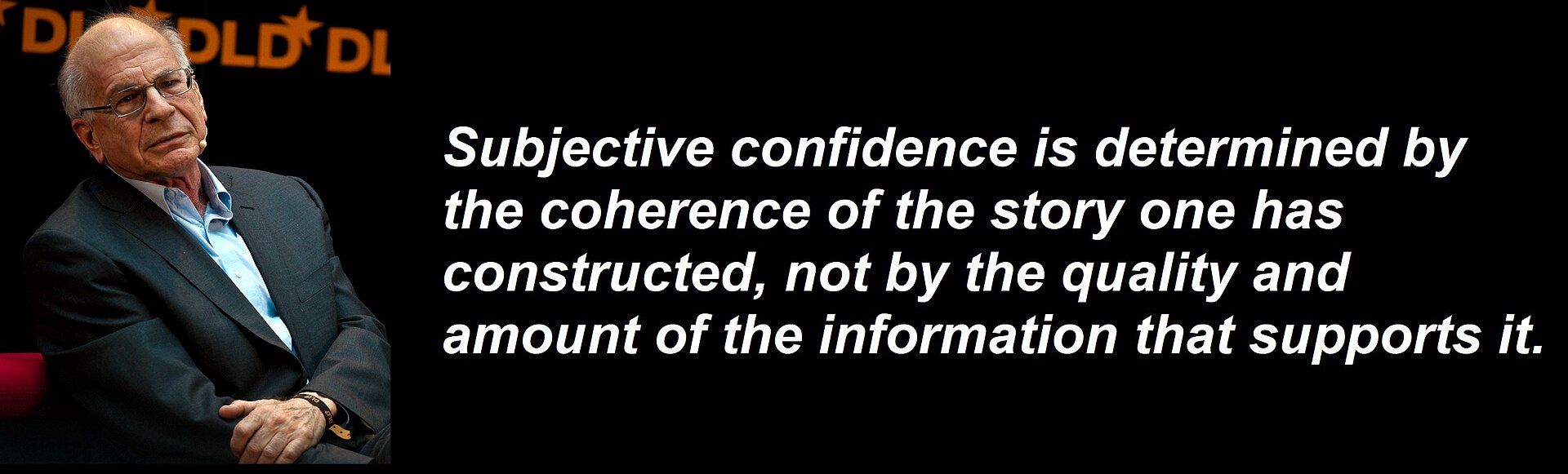
Daniel Kahneman was a psychologist who won the Nobel Prize in economics — a prize he collected, as he liked to point out, without ever having taken a single economics course. His life's work, done mostly with his collaborator Amos Tversky, showed that human beings do not decide the way economics textbooks say they should. We are not cool calculators. We are fast guessers with a slow editor — and the editor is usually asleep on the job.
Kahneman was born in Tel Aviv in 1934 and died in March 2024, at the age of 90. Across five decades he ran simple experiments that exposed the shortcuts in our thinking, and his 2011 book Thinking, Fast and Slow gathered a lifetime of that research into a single idea: the mind runs on two systems. This piece is research-based, drawn from his published work and the sources below — not an interview or a first-hand account.
System 1 is fast, automatic and effortless. It recognises a friend's face, reads a road sign, and finishes your sentence before you do. System 2 is slow, deliberate and effortful — the part that works through a maths problem or compares two insurance policies. Most of the time System 1 is in charge, and System 2 steps in only when something feels wrong or hard. The trouble, Kahneman argued, is that most errors of judgment happen when System 1 answers quickly and System 2 fails to check the answer. He was careful to say the two systems are a useful fiction for explaining the mind, not literal compartments in the brain — but as a way of thinking about thinking, they have proved hard to beat.
The same tired-System-2 story shows up in courtrooms. In a study of Israeli judges, parole was granted about 65% of the time just after a break and almost never just before one — a pattern we explored in our piece on decision fatigue. When the slow system runs out of energy, the fast one decides — and it decides no.
Kahneman and Tversky's most famous idea, prospect theory, published in 1979, says people judge outcomes as gains and losses from a reference point, not as final states of wealth. And losses sting more: losing a sum hurts roughly twice as much as gaining the same sum feels good. That asymmetry explains a lot — why investors hold losing shares too long, why we cling to bad decisions, and why a discount framed as avoiding a loss moves us more than the same discount framed as a gain. It is the same family of bias behind the sunk-cost fallacy: the urge to sit through a bad movie because you already paid for the ticket.
The most famous demonstration of all this is a puzzle Kahneman and Tversky published in 1983. They described a fictional woman, Linda — 31, single, outspoken, very bright, a philosophy graduate deeply concerned with discrimination and social justice, who had taken part in anti-nuclear demonstrations. Then they asked: which is more probable — that Linda is a bank teller, or that Linda is a bank teller and active in the feminist movement? In the original study, about 85% of participants picked the second answer. It is impossible: every feminist bank teller is first a bank teller, so the second statement can never be more probable than the first. But “bank teller and feminist” matches the Linda story far better than “bank teller” alone, so System 1 votes for the better story and System 2 lets it through. The puzzle still works on new audiences today — try it on a friend before you tell them the answer.
Kahneman met Tversky at the Hebrew University of Jerusalem in the late 1960s, and their collaboration became one of the great partnerships in science — Kahneman later described it as a time when each of them held the other's unfinished thoughts. Tversky died of melanoma in 1996, at 59. When the Nobel Prize in Economic Sciences came in 2002, it went to Kahneman — shared with the experimental economist Vernon Smith — because the prize is never awarded posthumously. Kahneman was open about how much of the work had been Tversky's, and how much it pained him to accept the honour alone.
The idea to remember is not that your brain is broken — it is that it is built for speed, not accuracy. System 1 will keep serving up confident, coherent answers. The trick Kahneman spent fifty years demonstrating is to pause before the decisions that matter and ask the slow question: would this still look right if I had to explain it step by step? Most of the time, the answer is worth the few seconds it costs.
Related on Poptani Labs: Decision fatigue: why judges said no before lunch, The sunk-cost fallacy: why you finish the bad movie, Ada Lovelace: the woman who wrote the first program for a computer that didn't exist. More in this category: Big Thinkers.
Sources: Q&As with Daniel Kahneman, PNAS, Conjunction Fallacy: Definition & Example (the Linda problem), Daniel Kahneman: Heuristics, Biases and Prospect Theory

