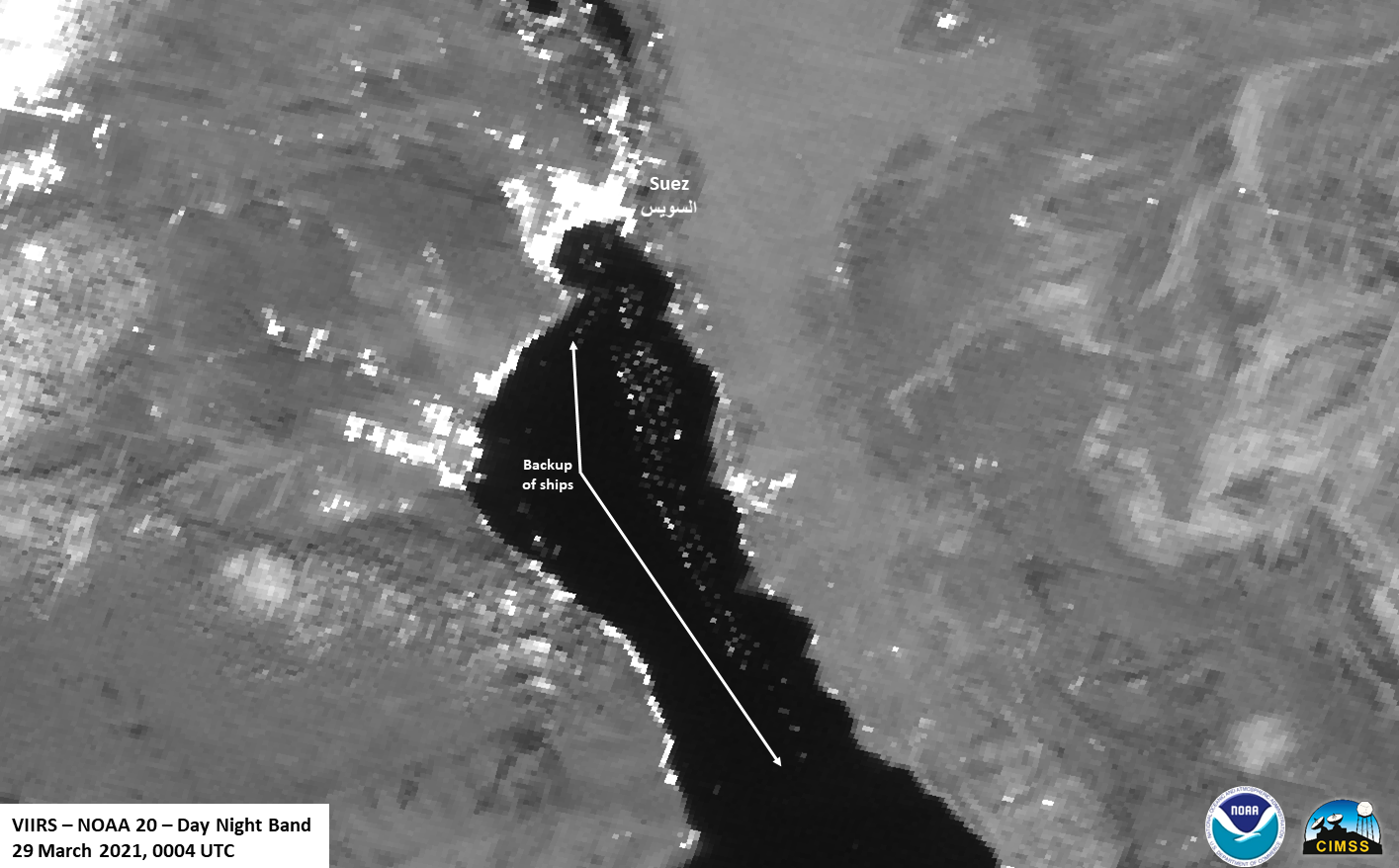
At 7:40 on the morning of March 23, 2021, a container ship the length of four football fields ran aground in the Suez Canal — and turned sideways. The Ever Given is 400 metres long; the canal is about 200 metres wide at that point. For the next six days, one of the world's busiest shipping lanes was completely closed, and roughly 12% of global trade simply stopped. It was the canal's longest closure since the 1967–1975 shutdown after the Six-Day War — and it was caused by a single ship, in a gust of wind.
The Suez Canal is a 193-kilometre artificial waterway connecting the Mediterranean and the Red Sea, opened in 1869. About 50 vessels a day pass through it — roughly 12% of global trade and about 30% of container traffic. When the Ever Given wedged itself diagonally, bank to bank, none of them could move. Lloyd's List estimated the value of goods held up at roughly $9.6 billion per day — about $400 million an hour. More than 400 ships queued at both ends of the canal or slowed mid-ocean to avoid arriving. Some carriers gave up waiting and turned for the Cape of Good Hope, adding around 6,500 kilometres and ten days to the voyage; for a ship averaging 12 knots, Suez to Amsterdam takes 13 days via the canal and 41 days around the Cape. Shipping rates for petroleum products nearly doubled in the aftermath.
Freeing a 220,940-gross-ton ship wedged in sand is not a matter of pushing harder. The Suez Canal Authority brought in tugs and dredgers, which dug around the bow and stern while tugboats pulled — and waited for help from the Moon. The refloat finally came on March 29, six days in, with a spring tide from the full moon raising the water level just enough, along with the dredging, to float the ship free. The operation's chief later said that anywhere else in the world it would have taken three months. The ship's name caused its own confusion in the meantime: "EVERGREEN" is painted in huge letters on the hull — but that's the operator, Evergreen Marine. The ship itself is the Ever Given.
Getting unstuck was only the start. Egypt impounded the ship, cargo, crew and all in the Great Bitter Lake for three months while negotiating compensation, opening with a claim of $916 million. The eventual settlement was confidential. Insurers called it a "large loss event" for the reinsurance industry, and the law firm Clyde & Co noted the legal tangle: each of the ship's 20,000 containers could have eight or nine different interests behind it. Meanwhile the queue took days to clear even after the canal reopened, and the backlog rippled through supply chains for weeks — a reminder that "just in time" has no slack for a canal that closes.
The blockage became the textbook example of chokepoint risk — the idea that global trade depends on a handful of narrow passages, and a single accident in one of them can cost billions. Egypt has since widened parts of the canal's southern stretch, where the grounding happened, to give ships more room. But the deeper fix — spreading supply chains so no single strait or canal can hold up 12% of trade — is slower, more expensive, and still mostly undone. The Ever Given was refloated, and eventually sailed on. The vulnerability it exposed is still sitting there, 193 kilometres long and 200 metres wide.
Six days, one ship, $9.6 billion a day. The Ever Given didn't sink, didn't spill its cargo, didn't even break apart — it just stopped, sideways, in the wrong place. Modern trade runs on the assumption that the narrow places stay open. For six days in March 2021, the world found out what happens when one of them doesn't.
Related on Poptani Labs: The canal that runs on rain: how drought squeezed world trade, The navy with no sea: why landlocked Bolivia still has sailors, Why the US dollar is so important to the world. More in this category: The World, Explained.
Sources: Ships.fyi, The six days that stopped world trade, NPR/WJSU, How A Long Shutdown Of The Suez Canal Might Have Roiled The Global Economy, MyGeoQuest, Suez Canal Blockage: Impact on Global Economy, Ballast Markets, How the Ever Given Blockage Cost $10 Billion

