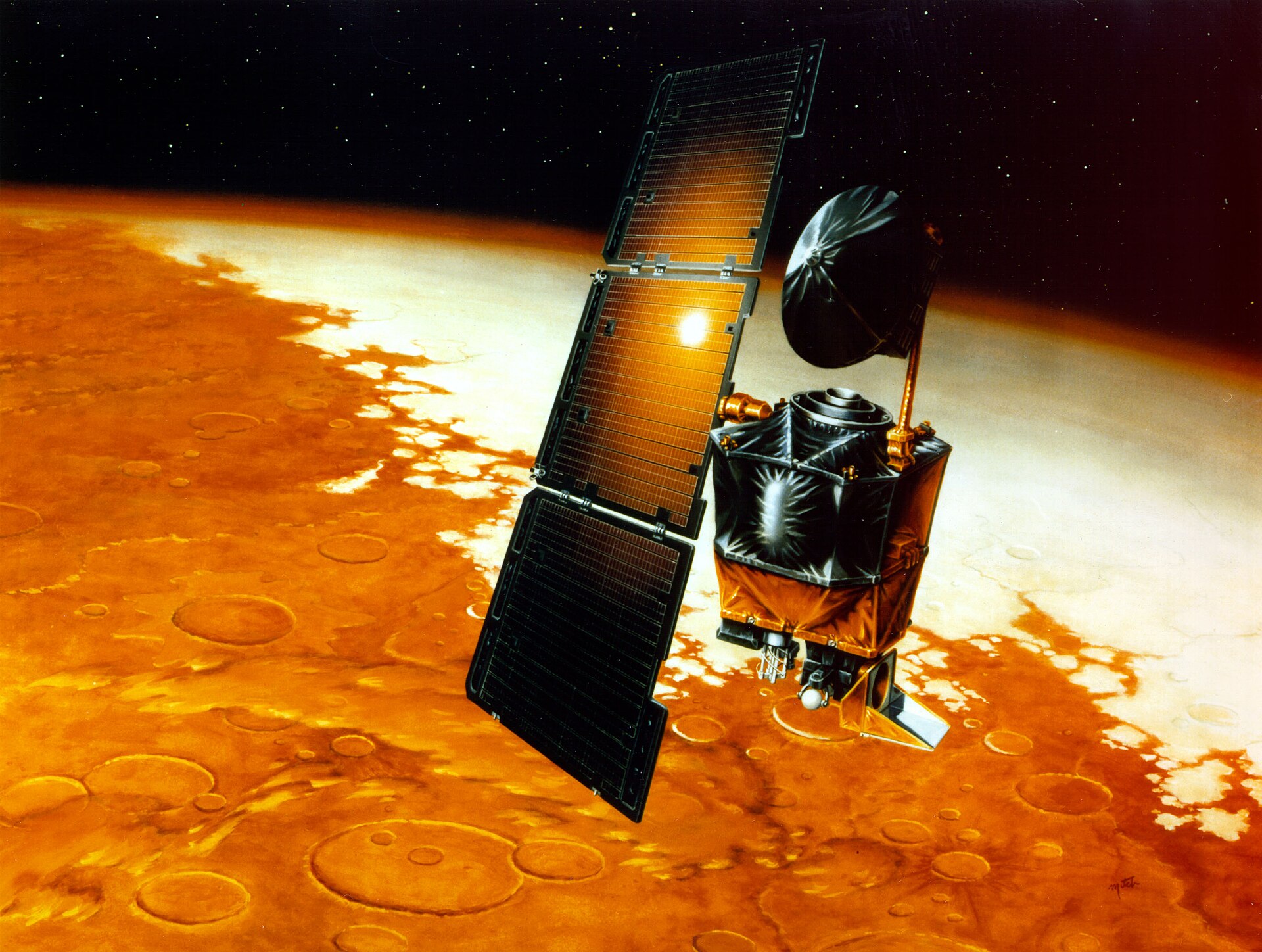
This is a research-based story: it is pieced together from NASA's own investigation report and mission pages, not from any first-hand access. On 23 September 1999, NASA's Mars Climate Orbiter fired its main engine to slip into orbit around Mars. Five minutes later it passed behind the planet, exactly as planned — and was never heard from again. A spacecraft that had flown 670 million kilometres over nine months was gone, and the cause turned out to be something almost embarrassingly small: two teams using different units for the same number.
The orbiter had two jobs. It was meant to become the first interplanetary weather satellite, mapping the Martian atmosphere — its dust storms, water vapour and carbon dioxide — over a full Martian year. It was also the communications relay for the Mars Polar Lander, due to arrive that December. Launched on 11 December 1998 aboard a Delta II rocket from Cape Canaveral, the 338-kilogram spacecraft carried a total mission price tag of $327.6 million: $193.1 million to build, $91.7 million to launch, and $42.8 million to operate.
Keeping a spacecraft on course is not one big steering wheel — it is hundreds of tiny nudges. Small thrusters fire regularly to stop the craft slowly spinning up, a routine called angular momentum desaturation. Each firing changes the spacecraft's velocity by a whisker, and navigators add those whiskers up to work out exactly where the craft is heading.
The trouble sat in a ground-software file with the unglamorous name "Small Forces". Lockheed Martin, which built the spacecraft in Colorado, wrote the program — SM_FORCES — that calculated the push from each thruster firing. The project's interface specification said those numbers had to be in newton-seconds, the metric unit of impulse. Instead, the file delivered them in pound-force-seconds, the imperial equivalent. One pound-force-second equals about 4.45 newton-seconds — so every impulse JPL's navigation software read was treated as roughly a fifth of its real size, and the trajectory model quietly drifted in the same direction, firing after firing, for nine months.
By arrival day, the models believed the orbiter would skim past Mars at about 226 kilometres. In reality it was headed for roughly 57 kilometres — below the 80 kilometres the spacecraft was thought able to survive. The main engine fired on schedule at 09:00:46 UTC on 23 September 1999, the craft slipped behind Mars, and its radio signal vanished at 09:04:52 UTC, 49 seconds earlier than expected. It was never heard from again. NASA's investigation later concluded it had burned up in the Martian atmosphere.
What makes the story sting is that the error left fingerprints. The little desaturation firings were happening 10 to 14 times more often than the navigation team expected — a glaring clue that the spacecraft was behaving differently from the model. At least two navigators noticed the growing gap between the predicted and measured positions and raised concerns; they were dismissed. The unit mismatch itself only came to light on 29 September, six days after the spacecraft was already gone.
Here is the detail that stays with you. Sixteen days before it was lost, the orbiter's Mars Color Imager took its first photograph of Mars — a dusty rose disc floating in black, captured from about 4.5 million kilometres away on 7 September 1999. The camera worked beautifully. The spacecraft was healthy, its instruments waking up one by one for a year of science that would never happen. The first picture of Mars it ever took turned out to be nearly its last act.
NASA moved fast. On 15 October 1999 it set up a Mishap Investigation Board chaired by Arthur Stephenson, and its Phase I report, published on 10 November, named the root cause plainly — the failure to use metric units in the "Small Forces" file — alongside eight contributing causes, from incomplete verification of the navigation software to an understaffed, under-trained navigation team. The board's recommendations went straight to the team preparing the Mars Polar Lander, already en route: verify the consistent use of units throughout that spacecraft, and audit software for compliance with its specifications — specifically, every piece of data passed between JPL and Lockheed Martin. NASA added its own measures too: a senior manager assigned to the lander effort, daily technical telecons, independent peer review of procedures, and a fully independent "red team" to sign off every fix. The lander was still lost that December, in a separate failure — and the twin losses forced a wholesale re-examination of NASA's "faster, better, cheaper" way of running Mars missions.
The orbiter was not lost to bad physics or a broken rocket, but to a number that crossed from one organisation to another without its unit attached — and to a system that never checked. NASA had been here before: a missing hyphen doomed Mariner 1 in 1962, and the pattern is the same. Every interface between two teams is a place where meaning can quietly change hands. The fix was never just "use metric"; it was to verify, end to end, that what one side sends is what the other side believes it received. That is a lesson worth carrying far beyond spaceflight — into any project where a small, unchecked assumption can steer the whole mission into the atmosphere.
Related on Poptani Labs: The missing hyphen that blew up a rocket to Venus, The butterfly ballot: how a confusing ballot design decided a presidency. More in this category: The Butterfly Effect.
Sources: Mars Climate Orbiter — NASA Science, Mars Climate Orbiter Mishap Investigation Board Phase I Report — NASA, Mars Climate Orbiter Failure Board Releases Report, Numerous NASA Actions Underway in Response — NASA, Mars Climate Orbiter MARCI Approach Image — NASA Science, Mars Climate Orbiter Investigation — Project Insider Asia

