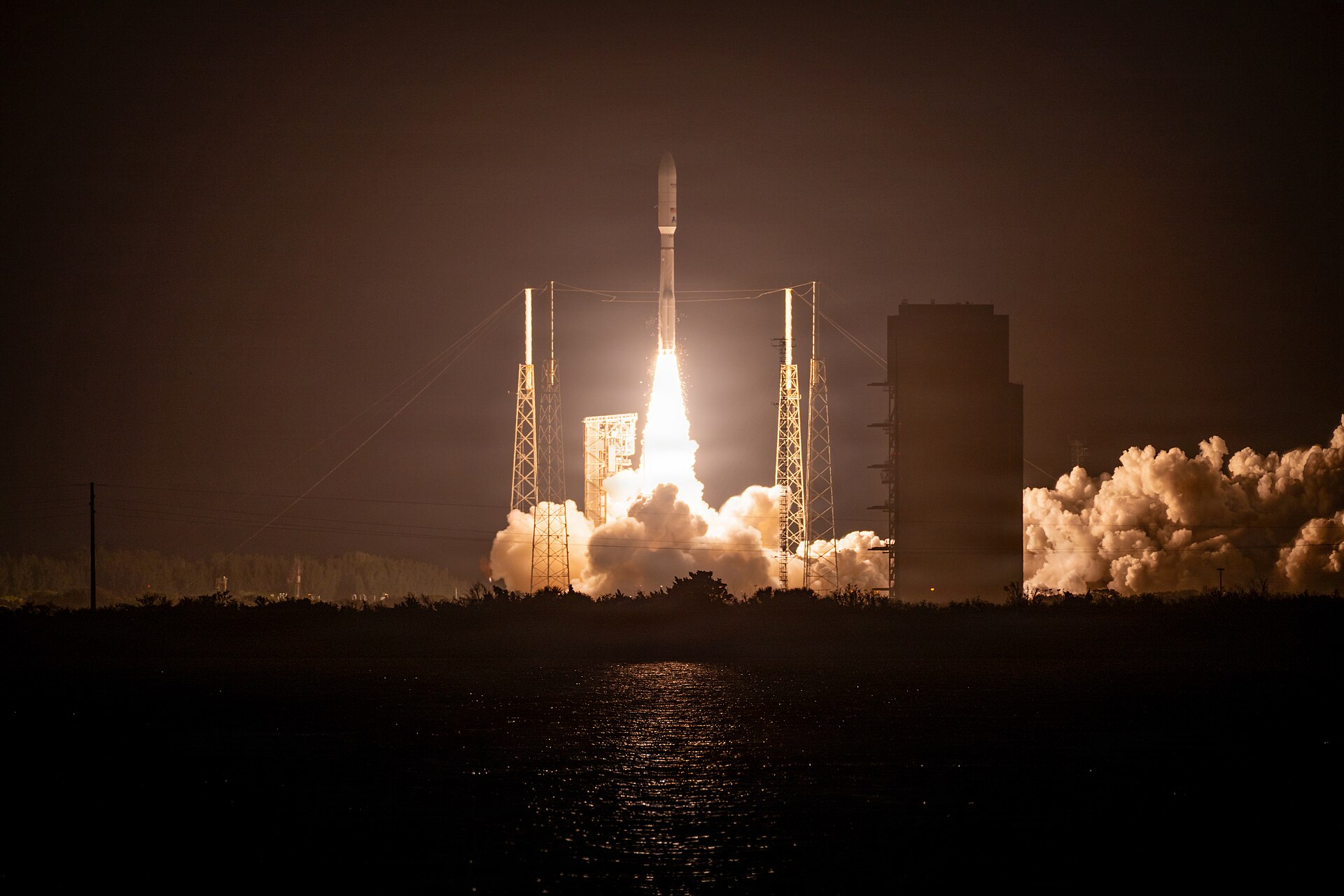
At 5:21 on the morning of July 22, 1962, an Atlas-Agena rocket rose from Cape Canaveral carrying Mariner 1, America's first attempt at an interplanetary probe. Its destination was Venus. It never got there. It was the first American spacecraft ever aimed at another planet. Two hundred and ninety-three seconds after liftoff, the range safety officer sent the destruct command, and the rocket — with the spacecraft and $18.5 million of 1962 money — blew apart over the Atlantic. The cause, found by engineers in five days, was a single missing mark in a guidance equation: a horizontal line the width of a hyphen.
The story is usually told as "a missing hyphen destroyed a rocket." The truth is slightly more technical — and more interesting. In the handwritten guidance equations, a variable marked with a small bar over it — R-bar — meant a smoothed, averaged value. When the equations were transcribed into the guidance computer's instructions, the bar was left off. The computer therefore used the raw, noisy measurement instead of the smoothed one. In the popular press the bar became a hyphen — the New York Times ran the headline "For Want of a Hyphen Venus Rocket Is Lost" — and science-fiction writer Arthur C. Clarke later called it "the most expensive hyphen in history."
The missing bar alone might never have mattered. During the climb, the Atlas booster's guidance antenna briefly lost its lock with the ground — a known, normally harmless glitch. The rocket was designed to coast along its programmed path until contact returned. But with the bar missing, the ground computer misread the noisy data as real movement and began issuing steering corrections that were not needed and not correct. Each small failure was survivable; together, they sent the rocket off course. The destruct command, sent with seconds to spare before the spacecraft was due to separate, was the right call: the vehicle was heading toward shipping lanes and populated coastline.
One detail from that morning is almost too strange to believe: after the destruct command, Mariner 1's radio transponder kept pinging flight control for another 67 seconds. The spacecraft's transmitter had survived the explosion and kept calling home until the wreckage hit the Atlantic. It is the kind of detail that sounds invented — and it is documented in the contemporary accounts of the launch.
Engineers at NASA's Jet Propulsion Laboratory needed only five days to trace the failure. Mariner 1's twin, Mariner 2, launched 36 days after the disaster and flew past Venus on December 14, 1962 — the first spacecraft ever to fly by another planet. Its instruments also settled a long argument about Venus, measuring a scorching surface temperature of around 800 degrees Fahrenheit beneath the clouds — far hotter than the swampy jungle many had imagined. The hyphen became a permanent fixture of software-engineering textbooks: a reminder that the most expensive bugs are often the smallest, and that the failure that kills a mission is rarely one mistake, but two small ones arriving at the same moment.
Mariner 1 is remembered for a hyphen that wasn't a hyphen. The deeper lesson is about redundancy: a system that survives one failure can still be killed by two at once. Every checklist, code review, and second pair of eyes in engineering exists because of mornings like July 22, 1962 — when a line the width of a hyphen, missed in transcription, was enough to end a mission to another world.
Related on Poptani Labs: The officer who ignored five nuclear missiles — and saved the world, The wrong turn that started a world war: Sarajevo, 28 June 1914, QF32: the A380 that lost an engine at 7,000 feet — and landed anyway. More in this category: The Butterfly Effect.
Sources: Fast Company, the most expensive hyphen in history, SpaceWar, the missing overbar in Mariner 1's guidance equation

