Almost everything you own has spent time inside a corrugated steel box: your phone, your shoes, the chair you are sitting on. The box itself is gloriously boring. What it did to the world is not. The shipping container did not just make freight cheaper — it rearranged where factories sit, which cities thrive, and how the entire global economy is organised. And it started with a truck driver getting annoyed at a dock.
Before containers, cargo travelled "break-bulk": crates, barrels, sacks and bales loaded onto a ship piece by piece by teams of longshoremen, then unloaded the same way at the other end, then loaded onto trucks and trains piece by piece again. A ship could spend more time sitting in port being loaded than it spent at sea. Every hand-off was a chance for damage, delay and theft, and every hand-off cost money.
Economist Marc Levinson, in The Box, calculated the 1956 numbers: loading a ship the conventional way cost about $5.86 a ton. Loading it with containers cost about $0.16 a ton. The ship was never the bottleneck. The transfer between ship and shore was.
Source: The Geography of Transport Systems — First Containership, Ideal-X, 1956
The fun part of this story is how ordinary its beginning was. In 1937, North Carolina trucking owner Malcom McLean drove a load of cotton bales to a pier in Hoboken, New Jersey — and then sat in his truck for most of the day, watching longshoremen unload his bales one by one onto a ship. The thought that stuck with him for the next nineteen years was simple: why unload the truck at all? Why not lift the whole trailer, cargo and all, onto the ship?
McLean was not, strictly speaking, the inventor of the container — boxes had been used on railways and canals long before him. His breakthrough was the system around the box: a container that could move from truck to ship to train without ever being opened. In 1955 he sold his trucking company and bought a small shipping line, Pan-Atlantic, to prove it.
Sources: Port Authority of New York & New Jersey — Port Newark: How Malcom McLean Changed the World, Guinness World Records — First container ship
On April 26, 1956, the converted Second World War tanker Ideal-X left Port Newark for Houston carrying 58 containers on a spar deck above its oil tanks. A crane set a box on deck every seven minutes, and the ship was loaded in under eight hours — work that would have taken days by hand. The following year, McLean's Gateway City carried 226 containers and could be emptied and reloaded in eight hours with two cranes.
But the box alone did not change the world. For a decade, the revolution nearly stalled on unglamorous obstacles: rival companies used different-sized boxes, dockworker unions feared for their jobs, and regulators priced freight by rules written for the old system. The breakthrough came from coordination, not invention. In 1960, West Coast dockworkers accepted mechanisation in exchange for a buyout fund. McLean gave up charging for his corner-fitting patents so any company's box could lock onto any ship. And in 1968, the International Organization for Standardization published ISO 668, fixing the 20-foot and 40-foot boxes — 8 feet wide, 8 feet 6 inches tall — that every port, crane, truck and train on Earth now recognises.
Sources: Port Houston — Ideal X, CHS Container Group — What Is ISO 668?
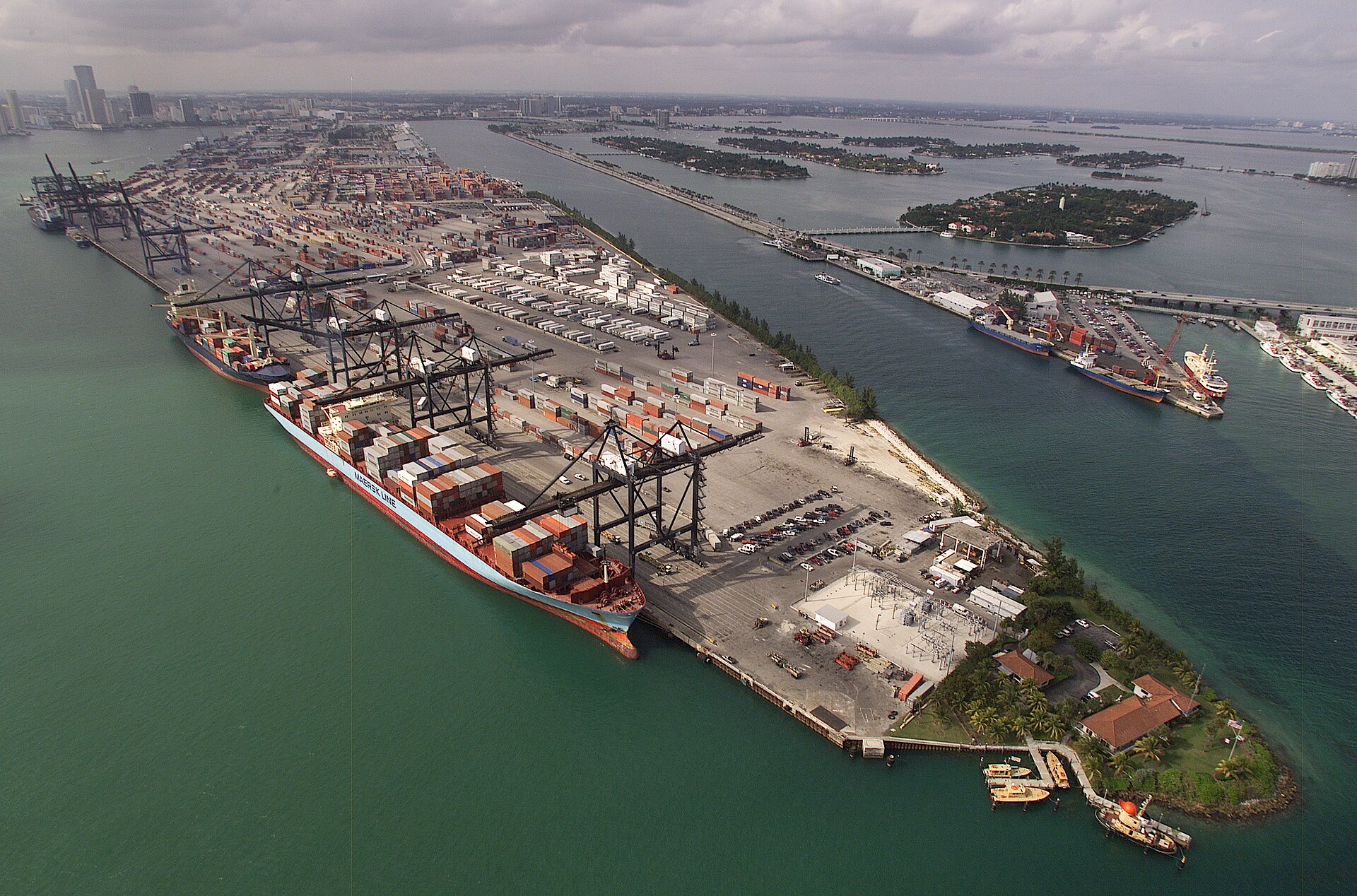
Once any box fit any ship, the whole geography of trade tilted. Ports rebuilt themselves around the box: in 1962 the Port Authority opened the Elizabeth marine terminal, the world's first purpose-built container port, while the old finger piers of Manhattan — built for gangs of men carrying cargo — faded away. Deep-water ports with room for giant cranes and container yards, like Rotterdam and Singapore, rose; ports that could not adapt shrank.
And then the deeper change arrived. When moving goods across an ocean costs almost nothing and arrives on a predictable schedule, a factory no longer needs to sit near its customers. Production split into chains: parts made in one country, assembled in another, sold in a third. Levinson notes that in the decade after containers first came into international use in 1966, trade in manufactured goods grew more than twice as fast as manufacturing production itself, and two and a half times as fast as global economic output. Economists Bernhofen, El-Sahl and Kneller later found containerization associated with a 320% increase in bilateral trade over five years, and 790% over twenty. The box, combined with the computer, also made just-in-time manufacturing practical — parts arriving hours before they were needed instead of sitting in warehouses for weeks.
Source: CEP Discussion Paper 2200 — Ports, technology and inter-city trade (LSE)
The numbers at the end of the chain are hard to picture. A single modern mega-ship can carry roughly 145 Ideal-X loads. Port Houston notes that it now moves the Ideal-X's entire volume in under five minutes. Roughly 90% of the world's non-bulk cargo now travels in standard boxes.
One caveat: the container did not do this alone — tariff cuts, computers and trade agreements helped. But the box is what made the rest pay off.
The shipping container's real lesson is not "invent something clever." It is "agree on the boring parts." McLean's box mattered only once everyone — rivals, unions, regulators, ports on different continents — accepted the same sizes, the same corner fittings, the same way of lifting. The invention took a year; the agreement took more than a decade, and the agreement is what changed the world.
That cuts both ways: standards pick winners and losers — dockworkers whose jobs vanished, port cities that guessed wrong, factories that moved away. Every chain has a cost, and it is worth remembering who paid for the difference.
More small causes, big consequences: the rounding error that discovered chaos theory, the wrong turn that started the First World War, and the dropped flask that invented safety glass. Or browse the full category: The Butterfly Effect.

