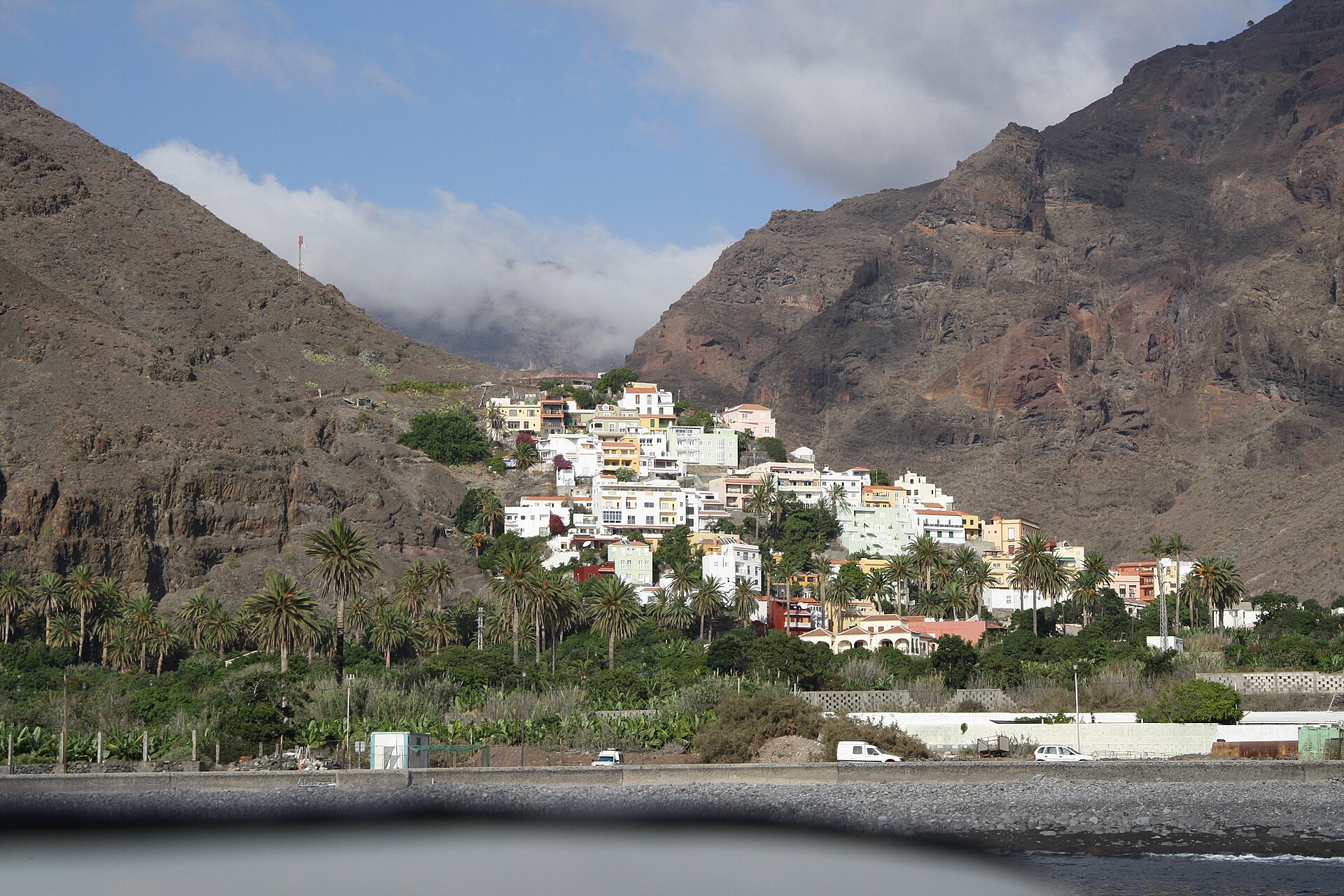
La Gomera is the second-smallest of Spain's Canary Islands, a volcanic lump of steep slopes and deep wooded ravines rising to nearly 1,500 metres. Shouting across one of those ravines doesn't work — the human voice fades within a few hundred metres. So the islanders learned to do something else: they whistle. Silbo Gomero is a whistled version of Spanish, used for centuries to send full sentences across valleys up to five kilometres away — farther than a shout, farther than a phone signal in the old days, and fast enough to beat a walk that would take an hour. This is a research-based piece — the story of a language, not a field trip.
Silbo Gomero is not a separate language and not a code. It is a transposition of spoken Spanish into whistling: the islanders' everyday language, re-encoded as pitch and rhythm. According to UNESCO's record of the tradition, it uses two distinct whistles for the five Spanish vowels and four whistles for the consonants — a small set of sounds, combined the way letters combine into words. Whistlers shape the sound with tongue and fingers, and a single whistled pitch sits between 1,000 and 3,000 hertz. That narrow, high-pitched band is the whole trick: a whistle concentrates sound energy into frequencies that travel much further through open air than the broad, low range of the human voice. A skilled whistler can be heard across a ravine three miles wide, and the message that arrives is not a signal — it is a sentence.
Before roads and telephones, Silbo was practical infrastructure. Shepherds and farmers working opposite sides of a barranco used it to pass news: market days, a ferry arriving, a neighbour needed at home, a public announcement for the village. The alternative was walking down into the ravine and up the other side — the better part of an hour, for a message that takes seconds to whistle. Its loudness is part of the design: Silbo was traditionally used for public communication as much as private conversation, because a whistle carries whether you want it to or not. The language is older than Spanish rule on the island — it was already in use among the ancient Gomeros, the Guanche people, long before the Spanish arrived, and it survived the centuries because the landscape never stopped demanding it.
Here is the part that surprised scientists. In a study published in the journal Nature, Manuel Carreiras and colleagues put proficient whistlers in a brain scanner and played them Silbo. The left temporal lobe — the region normally associated with processing spoken language — became active while they listened. The whistlers' brains were not treating the sound as music or birdsong. They were treating it as speech. That finding settled a long argument: Silbo is not a clever trick with sound, it is a language in every sense that matters, just carried on a different channel. A listener who doesn't know Silbo hears whistling. A listener who does, hears Spanish.
Silbo nearly died. As roads, telephones and then mobile phones reached the island, the need for whistling faded, and with it the speakers: a 2009 UNESCO survey found that all of La Gomera's roughly 22,000 residents understood the language, but only the older generation and the young people who had learned it in school could actually speak it. The island fought back. In 1999, Silbo was made a compulsory subject in La Gomera's schools, so every child on the island learns to whistle their own language. In 2009, UNESCO inscribed it on the Representative List of the Intangible Cultural Heritage of Humanity, giving the preservation effort international visibility and funding. Master whistlers still give demonstrations in Valle Gran Rey and San Sebastián de la Gomera, and the language is still used the old way too — across ravines, between farms, where a shout would never reach.
A language you can hear from three miles away, taught in classrooms, protected by UNESCO — and it exists because the island's valleys were too deep to shout across. Silbo Gomero is a reminder that human ingenuity doesn't always look like technology. Sometimes it looks like a shepherd, fingers in his mouth, whistling the news home across a ravine.
Related on Poptani Labs: Coober Pedy: the Australian town that lives underground, The Door to Hell: the desert fire that was supposed to burn out in weeks, The navy with no sea: why landlocked Bolivia still has sailors. More in this category: Around the World.
Sources: Wikipedia, Silbo Gomero, WorldAtlas, Did You Know About the Whistled Language of the Canary Islands?, The Vintage News, Silbo Gomero — An ancient and fascinating 'whistle language', Yoamore, The Last Whistlers: The Whistled Language of La Gomera

