No human has ever fallen into a black hole, and everything that follows is a prediction of general relativity, not an observation. But the physics is precise enough that we can say, with unusual confidence, exactly how the trip would go — and it turns out there are two very different deaths on offer, depending on which black hole you pick.
Approach any black hole and the first thing you meet is not darkness but tides. Gravity pulls harder on the part of you nearer the hole than on the part farther away, stretching you lengthwise while squeezing you sideways — a process Stephen Hawking popularised as "spaghettification". How violent it is depends entirely on the hole's size. Fall towards a black hole with the mass of our Sun, whose horizon is only about 2.9 km across, and the tidal acceleration across a 1.8-metre person at the horizon is roughly 19.6 billion m/s². You would be torn apart long before you crossed the horizon. Fall towards a supermassive black hole of 100 million solar masses, with a horizon some 295 million km wide, and the same figure is about 0.0000019 m/s² — less than the tidal pull you feel standing on Earth. Our own galaxy's central black hole, Sagittarius A*, weighs about 4.3 million suns with a horizon roughly 12 million km across, and its tides are comparably gentle. Pick the big hole, and you could cross the horizon without noticing anything at all.
Here is the strangest part, and it is the one people get wrong most often. To someone watching from far away, you would appear to slow down as you approached the horizon, redden as your light lost energy climbing out of the gravity well, dim, and freeze just above the edge — never quite crossing it. That is real physics, not an illusion. But it is only what the watcher sees. In your own time, you feel nothing special at the horizon and cross it in a finite amount of time. Both views are correct, each for its own observer; that is what general relativity says, and it is why the horizon is not a wall but a point of no return. Once inside, every path leads inwards, no signal can escape, and the end — whatever it is — is unavoidable. For a supermassive hole you might have minutes to hours after crossing before the tides overwhelm you. What waits at the centre is a prediction, not a known fact: general relativity says all matter ends at a singularity, a point of zero volume and infinite density where the equations themselves break down. Most physicists read that infinity as a sign the theory fails there, and that a quantum theory of gravity is needed. Candidates for what replaces it — Planck stars, fuzzballs, gravastars — are untested ideas, not answers.
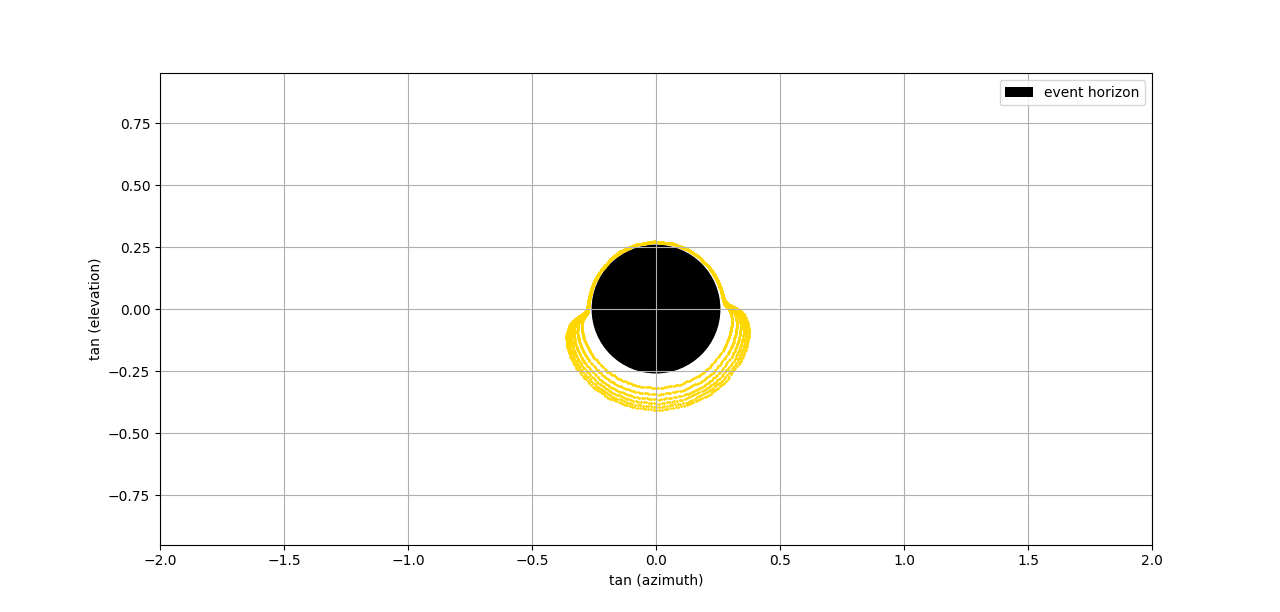
And here is the anecdote that proves how well we understand all of this, even without ever visiting one. For the 2014 film Interstellar, director Christopher Nolan hired Caltech physicist Kip Thorne as science advisor, and Thorne supplied equations from Einstein's general relativity. The visual-effects studio Double Negative built custom software that traced bundles of light rays through the curved spacetime of a spinning black hole, and produced Gargantua — a supermassive hole of 100 million solar masses, spinning at 0.999 of its maximum possible rate. The result was so scientifically accurate that the same team published two peer-reviewed papers on it. The film's signature image — the flat accretion disc's light bending over the top and under the bottom of the hole, so the far side of the disc appears as glowing arcs above and below the black shadow — was something no audience had ever seen, because no one had ever rendered it correctly before. Thorne's calculations even fixed the film's time dilation: one hour on the planet near Gargantua equals seven years on Earth, a factor of about 61,000, possible only because of that near-maximal spin. Nolan did make one deliberate cheat: the true render shows one side of the disc much brighter and bluer than the other, from relativistic Doppler beaming, and he dropped that lopsidedness because he thought audiences would find it confusing. Five years later, the Event Horizon Telescope's first image of the black hole in galaxy M87 showed the same dark shadow ringed by a bright warped photon ring — matching what Thorne and Double Negative had predicted. Thorne later shared the 2017 Nobel Prize in Physics for the detection of gravitational waves.
Falling into a black hole is the rare what-if where the science is ahead of the experience: we know the tides, the freezing, the one-way door, and we have even rendered the view correctly — five years before a telescope confirmed it. The one thing we do not know is what waits at the centre, and that is the honest edge of physics. The equations break; the story stops. Whatever replaces the singularity, nobody has seen it yet, and no one who goes to look is coming back to tell us.
Related on Poptani Labs: What if the Sun disappeared tomorrow?, What if gravity stopped for five seconds?. More in this category: What If?.
Sources: Astronomy.com, 'Ask Astro: Why are small black holes more dangerous than big ones?', LibreTexts, 'Spacetime Near Black Holes', James et al., 'Gravitational lensing by spinning black holes in astrophysics, and in the movie Interstellar', Classical and Quantum Gravity (2015), Science Museum, 'The Science of Interstellar', Space.com, 'What happens at the center of a black hole?'

