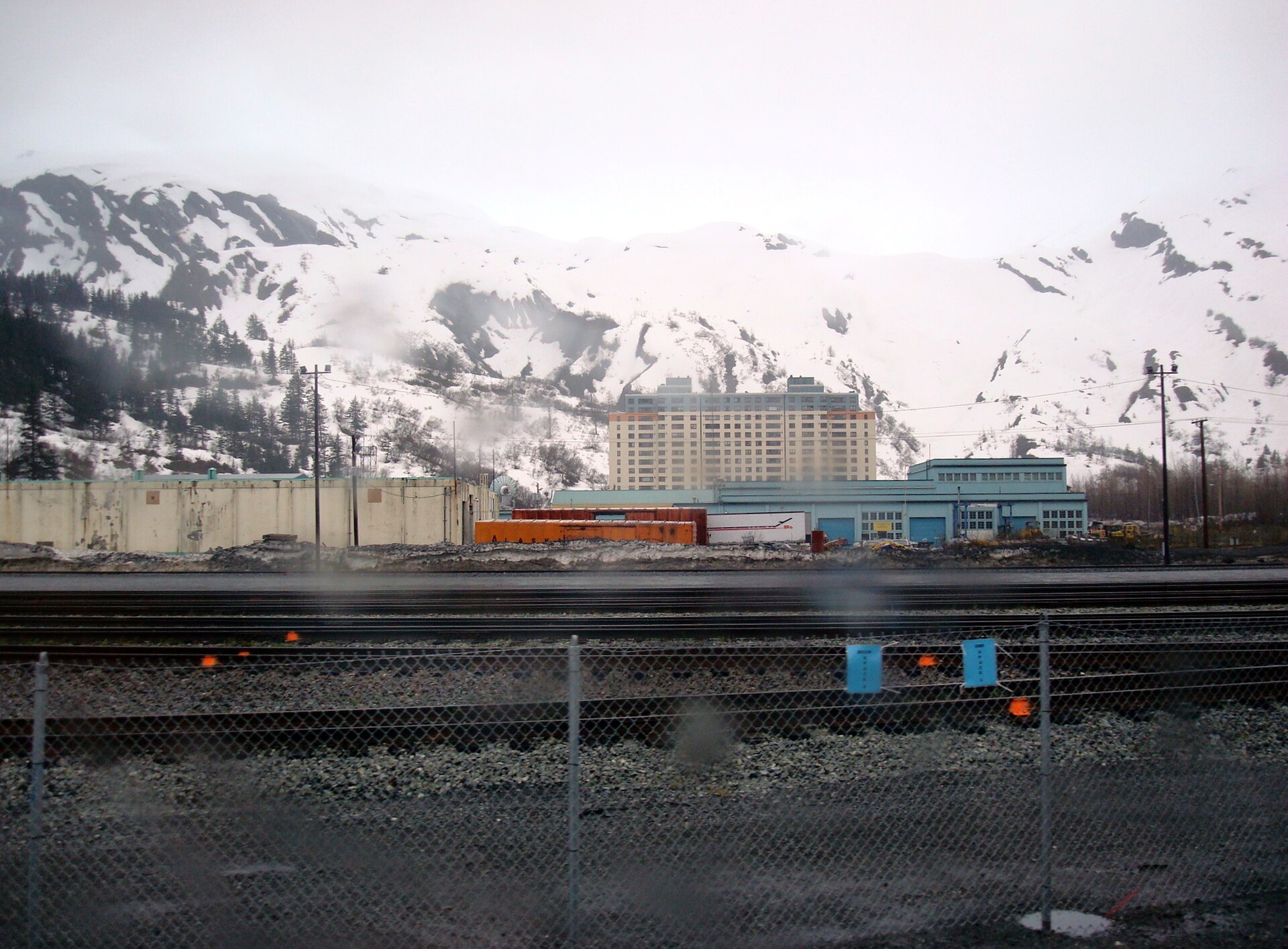
Whittier, Alaska, has about 270 residents, one grocery store, one post office, one police station, one church — and, for practical purposes, one address. Nearly the entire town lives in a single 14-storey building called Begich Towers, a former Cold War Army barracks that locals call the town under one roof. It is the only town in America where you can visit the mayor, post a letter, buy groceries and go home without ever stepping outside.
Begich Towers holds 197 apartments across three connected modules, and roughly 180 of Whittier's residents live there, with most of the rest in a second block nearby. The building is a small town in vertical form: along with the flats it houses a grocery store, a post office, a police station, a health clinic, a laundromat and a church, and the town's school is connected to it by an underground tunnel, so children can get to class in the depths of an Alaskan winter without going outdoors. Whittier sits on the shore of Prince William Sound, about 60 miles from Anchorage, hemmed in by steep, snow-covered mountains and some of the harshest weather in the United States. When a blizzard arrives, the town simply stays inside — because inside is, for most practical purposes, the town.
The building was never meant to be a town at all. During the Second World War, the US Army chose this spot for a secret military harbour and logistics base, and after the war it planned a complex of twelve multi-storey towers. Only two were ever completed. The first, designed in 1953 and finished in 1957, was the Hodge Building — named for Colonel William Walter Hodge, commander of the 93rd Engineer Regiment on the Alcan Highway — built as barracks and headquarters for soldiers and their families. The second, the Buckner Building, was even grander: living quarters for more than 1,200 people, with its own bowling alley, theatre and bakery. But the Army's plans shrank. By the early 1960s the military was pulling out, the 1964 Good Friday earthquake — the strongest ever recorded in North America — damaged the port, and the Buckner Building was abandoned in 1966. It still stands empty today. The Hodge Building survived by changing hands: in 1972 it was renamed Begich Towers in memory of Nick Begich, the Alaskan congressman who had disappeared in a plane crash nearby, and it passed to a residents' association in 1974.
Getting to Whittier is half the story. The town has one road in, and it runs through the Anton Anderson Memorial Tunnel: 2.5 miles long, the longest highway tunnel in North America, and a single lane shared by cars and trains. Traffic runs in alternating one-way convoys — cars one way, then the other, with Alaska Railroad trains slotted in between — at 25 miles per hour, taking about six minutes to cross under Maynard Mountain. The tunnel was built in 1943 as a rail-only bore and converted for cars in 2000; it was designed for temperatures down to minus 40 degrees and winds of 150 miles per hour, and it is the first tunnel in the United States to use jet-turbine ventilation to clear the air between trips. Miss your convoy window and you wait at the portal. It is the only town in America you can be locked out of by a timetable.
The most Whittier fact of all is a piece of paperwork. In 1973, the residents voted to buy the military facilities outright — the town literally purchased its own building, its port and its land from the government that had built them. A community of a few hundred people, living in a converted barracks at the end of a one-lane tunnel, decided that the simplest way to own their town was to buy it in one go. It is hard to imagine a more fitting origin story for a place that already does everything under one roof: even the purchase was collective, single and, in the end, practical.
Whittier is named for John Greenleaf Whittier, a 19th-century American poet who never set foot in Alaska. A town that lives in one ex-Army tower, reached through a one-lane tunnel shared with trains, carries the name of a Quaker poet from Massachusetts — which is exactly the kind of mismatch you get when a military harbour becomes a hometown by accident.
Related on Poptani Labs: Baarle: the town where the border runs through your front door, Giethoorn: the Dutch village with no roads — only canals. More in this category: Around the World.
Sources: Wikipedia, 'Begich Towers', All That's Interesting, 'Inside Begich Towers, An Entire Alaskan Town In One Building', ALASKA.ORG, 'Whittier Tunnel: Anton Anderson Memorial Tunnel'

