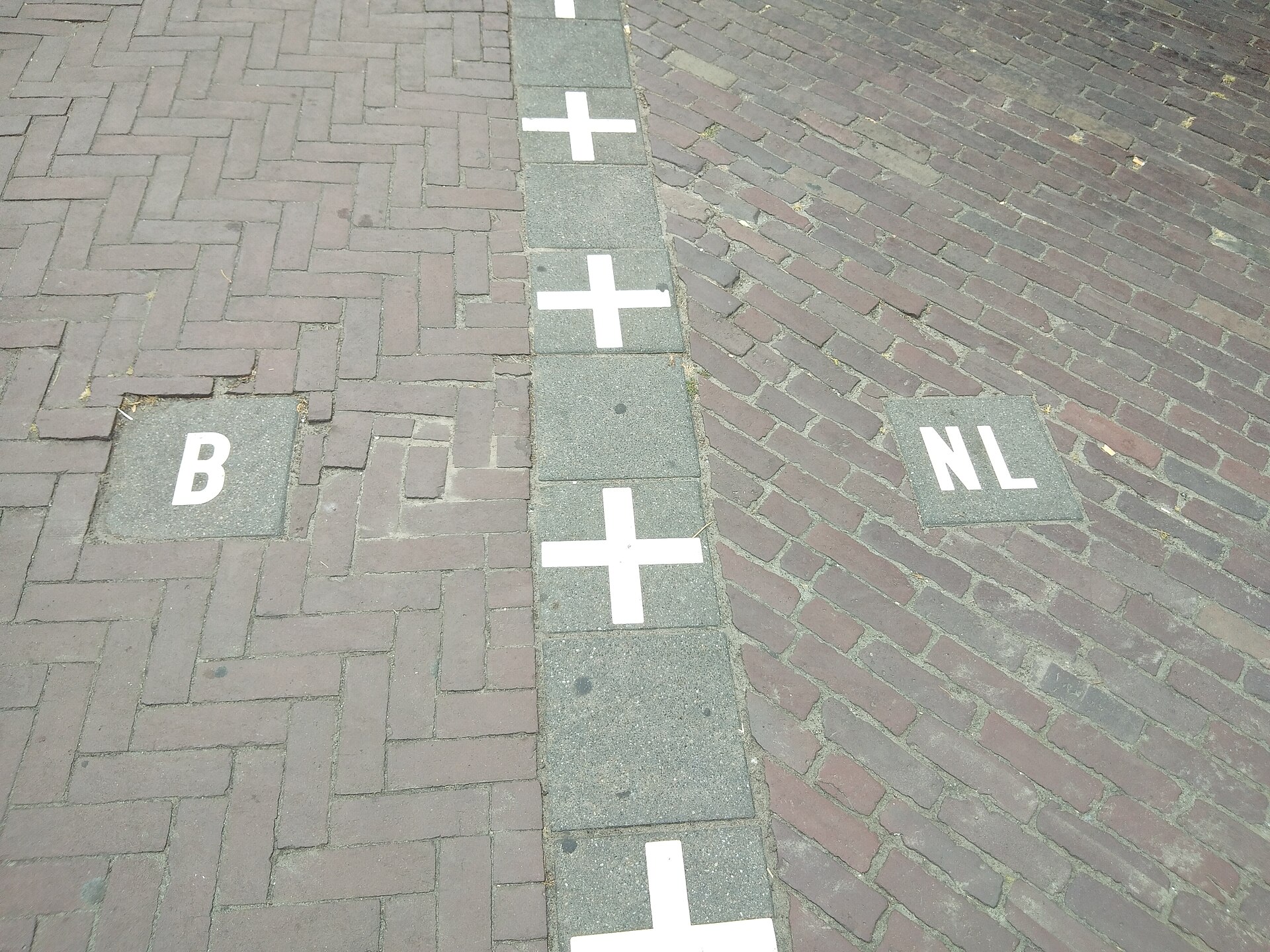
Stand on a street corner in Baarle and you are in two countries at once. Walk ten steps and you have crossed an international border three times. The border is not a fence or a river — it is a line of white crosses painted on the pavement, with a B on one side and NL on the other, running through front gardens, shop floors and at least one café bar. Baarle is one town that belongs to two countries, and it has been that way for eight hundred years.
Baarle is really two municipalities sharing the same streets: Baarle-Hertog, which is Belgian, and Baarle-Nassau, which is Dutch. Baarle-Hertog exists as 22 separate enclaves entirely surrounded by Dutch territory. Inside some of those Belgian pockets sit seven smaller Dutch counter-enclaves — patches of the Netherlands inside Belgium inside the Netherlands — and there is one more Dutch exclave just inside the Belgian mainland near the village of Zondereigen. Thirty pieces in all, fitted together like a jigsaw nobody ever finished. The two town halls stand a few hundred metres apart. About 2,500 people live on the Belgian side and about 6,000 on the Dutch side, in what is, to anyone walking through it, a single ordinary town.
The tangle dates to the twelfth and thirteenth centuries, when the land around Baarle was divided between the Duke of Brabant and the Lord of Breda. Parcels of farmland were handed out, swapped and inherited according to who owed allegiance to whom — and nobody ever tidied the map up. When Belgium and the Netherlands finally sat down to draw a proper border, the Treaty of Maastricht in 1843 took the extraordinary step of not drawing one at all: a commission went through 5,732 individual parcels of land one by one and assigned each a nationality based on its medieval ownership. The result looks less like a border and more like a spilled puzzle. The job was not even officially finished until October 31, 1995, when the last stateless parcel — a field of 2,632 square metres that had belonged to neither country for more than 150 years — was assigned to Belgium as its 22nd enclave.
In Baarle, the question of which country a building belongs to is settled by the voordeurregel — the front-door rule. Whichever country contains your front door, that is your country, wherever the rest of the house sits. House numbers show it: Belgian doors carry black numbers on white with a small Belgian flag; Dutch doors carry blue numbers. And because the rule is that literal, Baarle developed a tradition of moving front doors. More than one family has physically relocated its front door from one country to the other to change its address — and with it, its legal nationality, its taxes and its closing times. The one house that defeats the rule stands on Loveren street: the border runs exactly through the middle of its front door, so it keeps two addresses — Loveren 2, Baarle-Hertog, Belgium, and Loveren 19, Baarle-Nassau, the Netherlands — and two doorbells, one for each country.
The most famous consequence of the jigsaw was the café 't Hoekske, on the corner of Nieuwstraat and Stationsstraat, where the border ran straight through the bar. For years, Belgian and Dutch closing times were different — and when the hour came, the landlord did not close. He simply moved the tables to whichever side of the line was still allowed to serve. The same trick worked for the whole town in quieter ways: the side of the street you parked on, the shop you bought from, the café you sat in could all change which country's rules applied, without you ever leaving your seat. Today the closing times match and the trick is history — but the white crosses are still in the pavement, and the border still runs through the bar's old floor.
Baarle survives because nobody has ever found a reason to fix it. The border was drawn by medieval landlords, frozen by a nineteenth-century commission, and finished by a piece of paperwork in 1995 — and the people who live with it treat it the way you would treat a slightly eccentric neighbour: with patience, a sense of humour, and a front door in exactly the right place. It is a reminder that countries are, in the end, agreements — and that sometimes the agreement is a line of white crosses in the pavement, and a house with two doorbells.
Related on Poptani Labs: Coober Pedy: the Australian town that lives underground, Silbo Gomero: the island where people whistle across valleys, The navy with no sea: why landlocked Bolivia still has sailors. More in this category: Around the World.
Sources: Discovering Belgium, Baarle-Hertog, Focus on Belgium, a beer at the bar in Belgium, to the toilet in the Netherlands, Foxfire, the town that belongs to two countries

