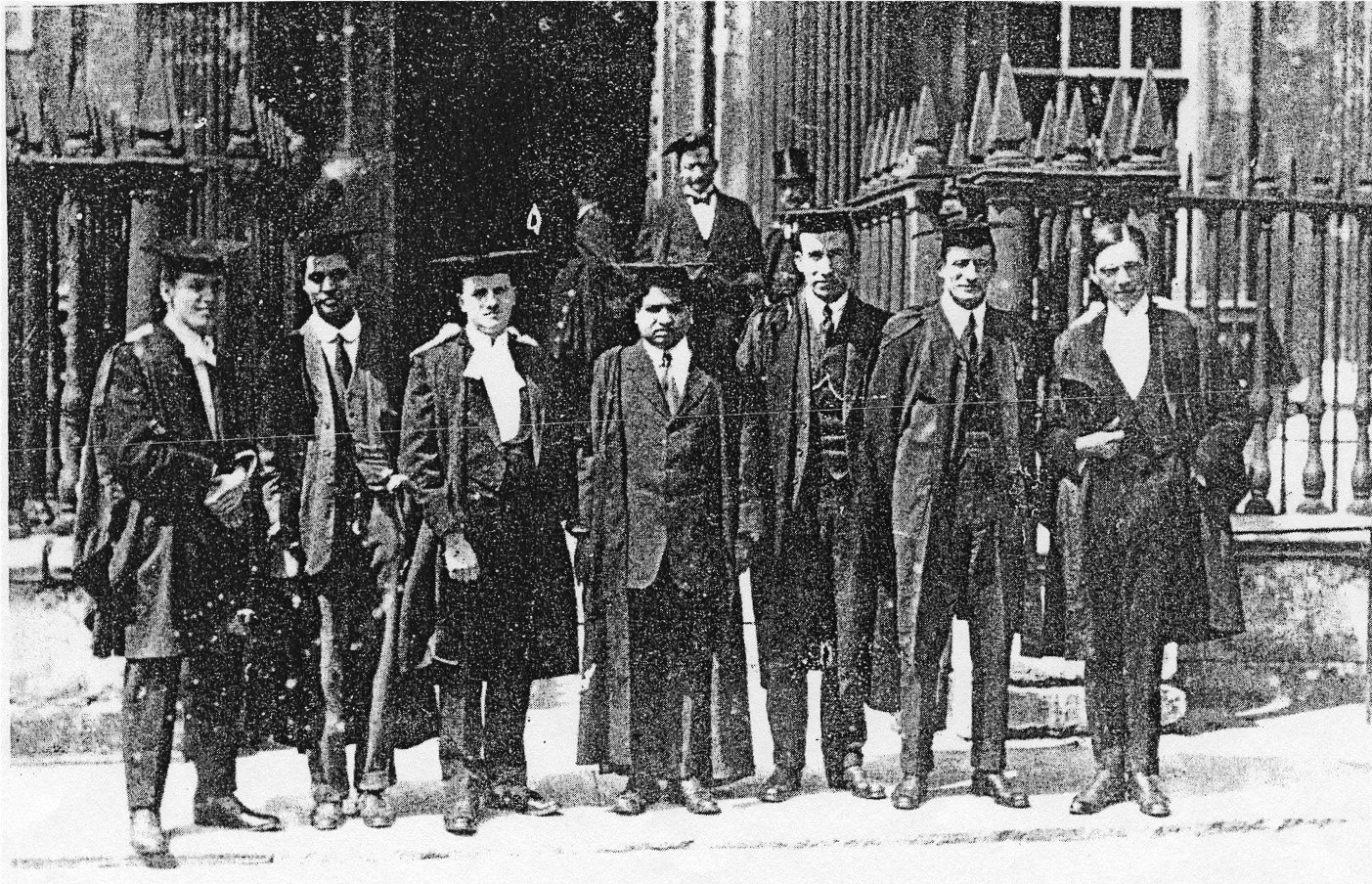
This is a research-based piece, drawn from the published record — Hardy's own memoir, the MacTutor archive at St Andrews, and the Royal Society's history. No invented dialogue, no dramatised scenes. The facts are strange enough on their own.
In January 1913, a 25-year-old clerk in the accounts department of the Madras Port Trust sat down in Kumbakonam and wrote to the most famous mathematician in England. He had no degree, no teacher, no formal training beyond school — only notebooks full of formulas nobody in India could check. The letter reached G. H. Hardy at Trinity College, Cambridge. Within a year he was in Cambridge. Within five, he was a Fellow of the Royal Society. He died at 32, and mathematicians are still proving his formulas a century later.
Srinivasa Ramanujan was born on 22 December 1887 in Erode, Tamil Nadu, and grew up in the temple town of Kumbakonam. A brilliant schoolboy, he won a scholarship to the Government Arts College there — then lost his way, mathematics crowding out every other subject until he failed his university examinations. He never took a degree.
The turning point came from a borrowed book. A friend lent him Carr's Synopsis of Pure Mathematics, a thick volume listing thousands of theorems, most stated without proof. Ramanujan set about proving them himself, then pushing past them, recording the finished formulas in notebooks — usually without the working. By the time he was a clerk in Madras, he had filled notebooks with results derived alone, in his spare time.
On 16 January 1913, Ramanujan wrote to Hardy, whose book Orders of Infinity he had studied, enclosing nine pages of mathematics — around 120 theorems, stated without proof — and introducing himself: he had had no university education, he wrote, but was "striking out a new path for myself".
Hardy's first reaction was suspicion: unproved theorems from an unknown clerk looked like a possible fraud. But he and his colleague J. E. Littlewood worked through the pages, and some of the results baffled even Hardy — results that took real effort to verify, and others he had never seen. On 8 February 1913, Hardy wrote back, keenly interested and asking for proofs. The University of Madras gave Ramanujan a scholarship that May, and in April 1914 he sailed for Cambridge.
Cambridge gave him colleagues to test his work, and a library. In five years he published more than 30 papers, earned a Cambridge degree by research in 1916, and on 2 May 1918 was elected a Fellow of the Royal Society — at 31, one of the youngest ever and only the second Indian admitted. That October he became the first Indian Fellow of Trinity College.
His range was astonishing — partitions, infinite series, prime numbers. In 1914 he published 17 formulas for calculating pi, one of which gives pi correct to seven decimal places from its very first term, and to fourteen from the second. In 1985 that formula computed pi to more than 17 million digits, a world record then.
But Cambridge was hard on him in other ways. A strict vegetarian, he cooked all his own food; wartime rationing in 1914–18 made that harder still, and his health, never strong, broke down in 1917. He spent long stretches in hospitals, working in between. In February 1919 he returned to India, still ill, and died on 26 April 1920, aged 32. He belongs with the outsiders who remade their fields — a generation later, Alan Turing at Cambridge, and in Paris, Marie Curie, whose notebooks are still too radioactive to touch.
The most famous Ramanujan story comes from Hardy himself. Visiting Ramanujan in hospital at Putney, Hardy mentioned he had arrived in taxi cab number 1729, a number that struck him as rather dull — and he hoped it was not a bad omen. Ramanujan disagreed at once: 1729, he said, was very interesting. It is the smallest number that can be written as the sum of two cubes in two different ways: 1³ + 12³, and 9³ + 10³. Hardy later wrote that every positive integer seemed to be a personal friend of Ramanujan's, and 1729 — the Hardy–Ramanujan number — is the proof. It is still the standard example in number theory.
Ramanujan kept working until the end. His last letters to Hardy, written in January 1920, described new functions he called "mock" theta functions — then died, with no proof and barely a definition attached. The notes behind them vanished into the papers of another mathematician, G. N. Watson, and sat unread for decades.
In the spring of 1976, the American mathematician George Andrews was going through Watson's papers in the Wren Library at Trinity College when he found them: 138 pages in Ramanujan's handwriting, more than 600 formulas, none of them proved. The manuscript became known as Ramanujan's lost notebook, and a photocopy edition appeared in the late 1980s. Andrews and Bruce Berndt then spent years — five volumes of work — proving the formulas one by one. The mock theta functions turned out to be deep mathematics, and have even found a use in black-hole physics.
Ramanujan's story is often told as proof that genius needs no training. That is the wrong lesson. He needed Hardy, and Cambridge, and years of patient checking — most of his formulas only became usable mathematics once other people proved them. What his life really shows is that a degree is a poor test of ability, and a letter can matter more than a certificate. A clerk from Kumbakonam wrote to a stranger in England, and his notebooks are still being unpacked a century later. That is the idea to remember: talent can show up anywhere, unannounced — and it is worth answering the letter.
Related on Poptani Labs: Alan Turing: the man who taught machines to think — and paid for being himself, Marie Curie: the notebooks too radioactive to touch. More in this category: Big Thinkers.
Sources: Srinivasa Ramanujan (1887–1920) — MacTutor History of Mathematics, Srinivasa Ramanujan — Wikipedia, Ramanujan's lost notebook — Wikipedia, A page from history: How Ramanujan became a Fellow of the Royal Society — The Hindu BusinessLine, Ramanujan — G. H. Hardy (1940), full text — Internet Archive

